
Last updated October 9, 2026
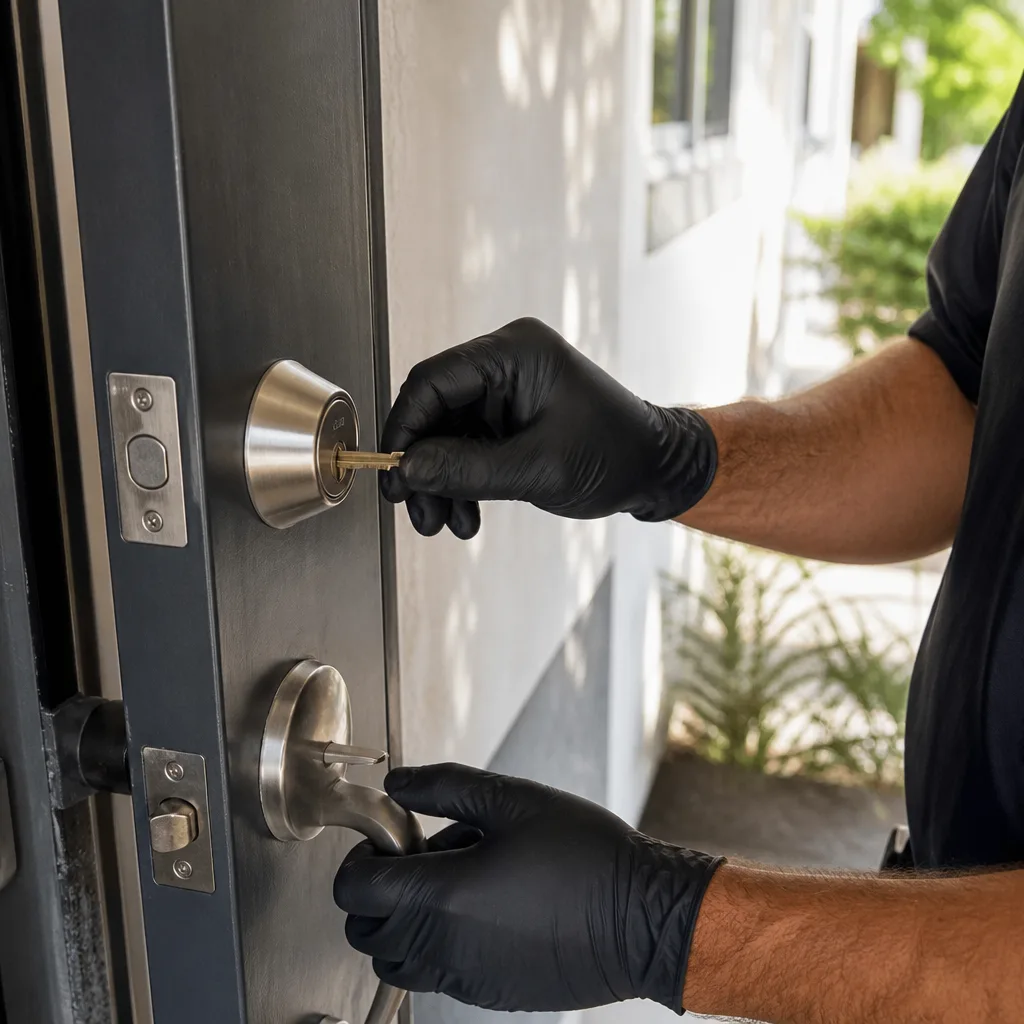
Non-destructive entry first, always - and we re-key Schlage, Kwikset, and Baldwin locks on the spot while you watch
You get a price before we start. It does not change when we arrive. No surprises.
 Before
 After
AfterLocksmith Emergency Preparedness Guide for Los Angeles Homes
After the 2023 Palisades brush fire evacuations, a pattern emerged that few homeowners anticipated. Several residents returned after clearance only to find they couldn’t get back in. They had evacuated with a car key and a phone. Their home’s smart lock had lost power during the outage, and the mechanical backup key was sitting in a kitchen drawer on the other side of a deadbolt. It took 30 minutes to prevent and hours to resolve under emergency conditions. This guide covers how to build an access plan for your Los Angeles home before you need one: which keys to stage, where to stage them, how smart locks actually fail in a crisis, and how to vet a locksmith when time is short and stress is high. For Locksmith Warning Signs: A Los Angeles Homeowner’s Reference Guide, see our companion post.
Quick Answer
Emergency locksmith preparedness in Los Angeles means having a physical key backup for every entry point, a known fail-safe for smart locks, a go-bag that includes the right keys and lock documentation, and a verified locksmith’s number saved in your phone before anything goes wrong. It’s not about buying new hardware. It’s about making sure the hardware you already trust can’t lock you out when conditions change fast.
Table of Contents
- Building a Key Management Plan That Survives an Emergency
- Smart Lock Failure Modes in Los Angeles Emergencies
- Wildfire Season Preparation: Keys, Go-Bag, and Lock Documentation
- Post-Earthquake Protocol: Doors, Frames, and Deadbolt Alignment
- Vetting an Emergency Locksmith Under Pressure: The Three-Question Check
- Lockbox Strategy: Where Backup Keys Actually Belong
- Common Mistakes to Avoid
- When to Call a Professional
- Frequently Asked Questions
- The Bottom Line
Building a Key Management Plan That Survives an Emergency
A key management plan is a written record of who has access to your home and how. Most homeowners can’t answer two basic questions: How many copies of my front door key exist, and where are they right now? In an emergency, that ambiguity costs hours.
Start with an inventory. Walk through your home and count every keyed entry: front door, back door, side door, garage service door, deadbolts, gate locks, window locks. Write down how many keys exist for each. Then write down who holds them. A neighbor, a relative in Pasadena, a house cleaner, a dog walker. If you can’t name the person holding a copy, assume you need a rekey.
The plan needs three layers:
- Physical backup keys stored off your property. Give a full set to a trusted person who lives within 30 minutes of your Los Angeles neighborhood. In an evacuation, you may not be able to reach someone across the county. Close matters.
- An on-property lockbox with a mechanical combination. More on placement and strategy below. This is your fastest self-rescue option.
- A documented locksmith contact. Not a search result. A saved phone number you’ve already used or vetted. Under stress, typing “emergency locksmith Los Angeles” into a search bar gets you marketers, not necessarily licensed technicians.
We’ve handled calls in Silver Lake, Eagle Rock, and Koreatown where the homeowner knew they had a key “somewhere” but couldn’t reach it. The difference between a 20-minute resolution and a three-hour ordeal is almost always whether a backup key actually exists outside the house.
Smart Lock Failure Modes in Los Angeles Emergencies
Smart locks fail in predictable ways, and none of them care how much the hardware cost. Three failure modes matter in Los Angeles specifically: power outages, Wi-Fi disruption, and dead batteries. Each deserves its own line in your preparedness plan.
Power outage. During Santa Ana wind events, utilities shut off power proactively in high-risk wildfire zones. If your smart lock relies solely on a wall-powered hub or a Wi-Fi bridge with no battery backup, it goes offline. Some models retain limited local function. Some don’t. The lock still works mechanically if you have the key. If you left the key inside, you’re locked out by a design assumption that power stays on.
Wi-Fi disruption. Many smart locks still allow entry via Bluetooth, keypad, or fingerprint even when Wi-Fi drops. But remote access features, temporary codes, and app-based unlocking stop working. If you’ve been relying on your phone as your only key, that’s a single point of failure. Phones get left behind in evacuations. Phones die. Phones get dropped on a driveway in the rush to leave.
Dead batteries. Most smart locks give low-battery warnings for weeks before they fail. If you’re in the middle of an event, those warnings stop being helpful. A lock that worked this morning can be dead by evening if the battery was already critical. The fix is a replacement schedule, not a hope.
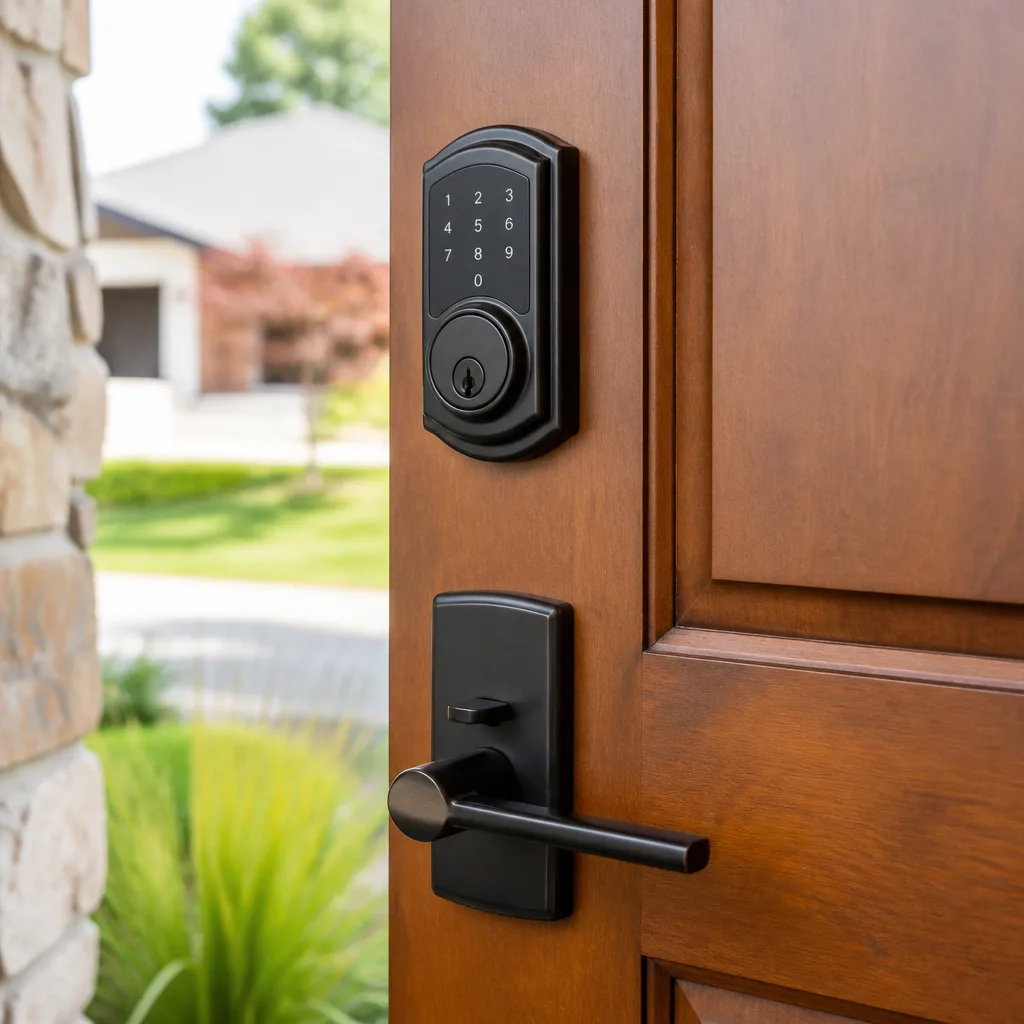
The key question for any smart lock: does this model have a reliable mechanical key override? Brands like Kwikset and Yale offer smart locks with a physical key cylinder built in. That means the lock still opens with a traditional key, even if the electronic deadbolt brain is completely offline. If your smart lock doesn’t have a key override, or you don’t carry that key, treat the smart features as convenience, not as your emergency access plan.
Test your override key quarterly. Go outside, lock the door, and open it with the metal key. If the key turns, you have access. If it binds or won’t turn, call a locksmith before you need that lock in an emergency.
Wildfire Season Preparation: Keys, Go-Bag, and Lock Documentation
Wildfire season in Los Angeles now runs year-round in practice, but the critical window runs from late summer through the first heavy rains. Preparation means having three things done before an evacuation order appears on your phone: the go-bag keys, the lock inventory, and the saved locksmith contact.
The go-bag keys. Your evacuation go-bag needs a set of physical keys: house, garage, gate, mailbox if it’s keyed, and any outbuilding. Attach them to a carabiner or a key ring inside the bag where you won’t have to search for them. Include one smart lock override key if your lock has one. The point is that you grab one bag and you have physical access to everything you own.
The lock inventory. Photograph every lock on your property: front door, back door, garage, gates, windows if they have keyed locks. Get close enough to capture brand names and any visible markings. Take a second photo of the key for each lock. Store these photos in a cloud folder separate from your phone’s local storage. After a fire or a break-in, your insurance claim moves faster when you can show exactly what hardware existed and what condition it was in.
The saved locksmith contact. Write down a locksmith’s direct number and keep it in two places: your phone contacts and a paper card in your go-bag. Why paper? Because phones die, phones get lost, and phone screens crack at the worst possible time. A card with one number on it is worth more than a search engine full of options when you need someone fast.
Los Angeles neighborhoods in the wildland-urban interface, from the foothills of the San Gabriel Valley to the canyons off the 405, have different evacuation realities than a Mid-Wilshire condo. If you live where a fire order is more likely, your key plan matters more. But every Los Angeles home benefits from a go-bag that includes physical keys, because the failure mode is the same everywhere: under stress, people forget the thing they left in a drawer.
Post-Earthquake Protocol: Doors, Frames, and Deadbolt Alignment
Seismic movement does two things to doors: it shifts door frames out of square, and it moves the strike plate relative to the deadbolt or latch. A door that sticks after an earthquake is not necessarily broken. A door that won’t open or won’t lock is a different problem.
Stuck door. If the door binds at the top or bottom but the handle and deadbolt still operate, the frame has likely shifted a fraction of an inch. This is common after even moderate shaking in Los Angeles. The immediate fix may be as simple as lifting the door slightly by the handle while turning the key. If the deadbolt fully retracts but the door still sticks, the problem is the frame, not the lock. A locksmith can adjust the strike plate or re-set the door. A contractor may be needed if the frame itself has moved.
Structurally compromised door. If the door is visibly out of plumb, if there are new cracks in the wall above the frame, or if the door is jammed so hard it won’t budge at all, do not force it. Forcing a door through a shifted frame can split the door, break the lock, or injure whoever is pushing on it. This is a structural issue. Call a contractor or a structural specialist first. A locksmith can secure the door after the structural work is done.
Deadbolt alignment. After an earthquake, a deadbolt may not throw fully because the bolt no longer lines up with the strike plate hole. You can check this visually: with the door open, throw the bolt and look at where it extends. Then close the door slowly and see where it meets the plate. If the bolt hits the edge of the plate hole, the alignment is off. A locksmith can file or reposition the strike plate, and this is usually a quick job.
Wait for a locksmith to address alignment issues. Forcing a deadbolt against a misaligned strike plate bends the bolt, wears the internal mechanism, and eventually turns a $150 adjustment into a full lock replacement.
In our experience across Los Angeles, most post-earthquake door problems are minor misalignments that take under an hour to fix. The dangerous ones are obvious: visible frame movement, cracked wallboard, a door that visibly sags. Know the difference before you start pulling on things.
Vetting an Emergency Locksmith Under Pressure: The Three-Question Check
Emergency lockouts put homeowners in a vulnerable spot. You’re stressed, it’s often late, and you need someone at your door fast. The locksmith industry has a documented problem with bait pricing: a low quote on the phone, and a much higher bill once the technician arrives. Los Angeles is a dense market with plenty of legitimate shops and a persistent share of bad actors.
Before you hand anyone a key to your home or a screwdriver near your locks, ask these three questions. The whole conversation should take under two minutes.
- What is the full price, including service call, labor, and hardware, and will you confirm it in writing before you start? A legitimate locksmith gives a complete number and a written price before touching anything. If the answer is vague, if they say “it depends,” or if they won’t commit in writing, hang up. The price you agree to on the phone should be the price on the invoice. No arrival surcharges, no “this lock is harder than I thought” adjustments.
- Do your technicians arrive in marked vehicles, in uniform, and can they show ID? Reputable Los Angeles locksmiths send identifiable employees, not subcontractors in plainclothes from an unmarked van. The person at your door should be able to tell you who they work for and prove it. If they can’t, don’t let them touch your lock.
- Are you licensed and insured, and can you tell me the locksmith’s direct phone number so I can call back if there’s a problem? A real shop gives you a number that reaches a real person. If the call came through a national call center and you can’t get back to the same company after the job, you have no recourse if something goes wrong.
The time to run this check is before the emergency. Call a local shop during normal hours. Ask these three questions. If they answer well, save the number. When the 11 p.m. lockout happens, you’re calling a known quantity instead of gambling on a search result.
Lockbox Strategy: Where Backup Keys Actually Belong
A lockbox is a small hardened container that holds one or two keys and opens with a mechanical combination. For Los Angeles homeowners, it solves a specific problem: maintaining fast emergency access without hiding a key where a burglar looks first.
The classic mistake is the fake rock, the key under the mat, or the key taped under a planter. These spots are known to every burglar in the city, and they fail exactly when you need them because someone else found the key first. A proper lockbox changes the equation.
Where to mount it. Choose a location that’s visible enough to be found by someone you’ve told about it, but not obvious from the street. A side gate post, a sturdy pipe behind a shrub, or a water heater enclosure away from the front door. The box should be mounted with the included hardware, not left loose. A loose lockbox is a portable gift to anyone who spots it.
What to put in it. One or two keys maximum: front door and a secondary entry like a back door. Don’t put gate keys, car keys, or mail keys in the same box. Keep the box’s purpose narrow: emergency house access.
Register the location with a trusted contact. At least two people should know the lockbox exists, its exact location, and its combination. Store the combination in your phone, in your go-bag, and in the home of a family member. This is the step most people skip: they install a lockbox, then find themselves standing in front of it six months later with no memory of the code.
Change the combination after you share it. If a contractor, cleaner, or housesitter used the lockbox, reset the code when the work ends. The entire point is controlling who has access. A code that’s been shared five times is no longer a secret.
For homeowners with a rekey need in Los Angeles, a lockbox also makes the job easier: the technician can access the home without requiring the homeowner to be present for the entire visit, though we recommend being there for at least the initial walkthrough.
Common Mistakes to Avoid
- Relying on a smart lock as your only entry. Power fails, batteries die, and Wi-Fi drops. If there’s no mechanical key override and you don’t carry that key, you’ve built a lockout into your own security.
- Hiding a key in an obvious spot. The fake rock, the mat, the top of the door frame are all known to anyone who wants in. A lockbox with a mechanical combination is a better answer.
- Not knowing how many key copies exist. If a previous owner, a contractor, or an ex-tenant has a key and you can’t account for it, your lock isn’t securing anything. Rekeying fixes this for a fraction of the cost of new hardware.
- Calling the first locksmith in a search ad under stress. That’s how the bait-price game works. Vetting a locksmith during normal hours takes ten minutes and protects you when you don’t have time to think.
- Forcing a stuck door after an earthquake. A shifted frame can turn a minor lock adjustment into a broken door and an injured hand. Check the frame, check the deadbolt, and call someone if it won’t move with normal force.
- Leaving backup keys only with someone across the county. In a real emergency, distance is the enemy. A trusted person 20 minutes away is a plan. A cousin in Long Beach when you live in Northridge is a narrative.
When to Call a Professional
Some access problems are DIY territory. Others aren’t worth the risk. Call a professional locksmith when a lock has failed after a break-in or break-in attempt, when a deadbolt won’t throw after seismic activity, when keys are lost and you don’t know who might have copies, or when you want a security upgrade done to a standard you can rely on. Rekeying a lock after a move-in, a tenant change, or a lost key is a fast job that restores control. If you’re uncertain whether a door problem is a loose strike plate or a shifted frame, a professional inspection answers the question in minutes. Ridley Locksmith & Security offers free estimates for Los Angeles homeowners, and a live person answers the phone at (956) 275-7388 any hour, any day.
Frequently Asked Questions
First, check every door and window you might have left open, then call a locksmith you’ve already vetted if possible. If you don’t have one, ask the three questions above: full price in writing before work starts, marked vehicle and uniformed technician, and a direct number to call back with problems. A reputable locksmith will answer all three without hesitation.
For a standard lockout or rekey in Los Angeles, expect a service call fee plus labor, with a written total you agree to before work starts. Residential lockouts typically run $75 to $250 depending on time of day and lock complexity. Rekeying runs $60 to $180 depending on the number of locks and cylinders. Get the full price on the phone before anyone is dispatched, and get it in writing when the technician arrives.
Rekeying changes the internal pins of an existing lock so the old key no longer works, leaving the same hardware in place. It’s faster and less expensive than replacing locks, and it restores full security when you’re not sure who found the key. You only replace hardware when it’s worn, damaged, or you want a higher-security lock.
A smart lock with a mechanical key override remains functional during a power outage, because you can open it with a physical key. A smart lock without a key override, or with a dead battery, may leave you locked out when the power fails. Always carry the metal key for any smart lock you install, and test it regularly.
Ask for proof of licensing and insurance before any work starts, and verify that the technician arrives in a marked vehicle with company identification. A legitimate Los Angeles locksmith will show credentials without being asked twice. Be wary of unmarked vans, generic “locksmith service” branding, and technicians who can’t name their employer.
Yes, if the issue is deadbolt or latch misalignment from a shifted strike plate. If the door frame itself has moved significantly, that’s structural work and a contractor should address it first, after which a locksmith can reset the lock. Never force a jammed door after seismic activity; it risks further damage and injury.
The Bottom Line
Los Angeles access emergencies come in recognizable patterns: smart locks failing during outages, keys lost to the fog of an evacuation, doors warped by seismic movement, and homeowners caught without a plan. The fixes are straightforward and far cheaper than the emergencies they prevent. Stage a physical key outside your home in a registered lockbox. Put a key set in your go-bag. Photograph your lock hardware for insurance. Save a vetted locksmith’s direct number. Know the three questions to ask when stress is high and time is short. These steps take a few hours to implement and pay off the day you need them. Find more guides & resources on our blog.
Ridley Locksmith & Security is a local Los Angeles locksmith operating under The Garrison Standard since 2007. We serve residential and commercial clients throughout the city, and every job carries a written price before work starts and a written guarantee covering the repair for one full year. If the work fails inside that window, we return at no charge. For a free estimate on residential locksmith work in Los Angeles or commercial locksmith service, call (956) 275-7388. A live person answers, around the clock.
Written by Drew Kowalski, Owner at Ridley Locksmith & Security, serving Los Angeles since 2007.