
Last updated October 9, 2026
Non-destructive entry first, always - and we re-key Schlage, Kwikset, and Baldwin locks on the spot while you watch
You get a price before we start. It does not change when we arrive. No surprises.
 Before
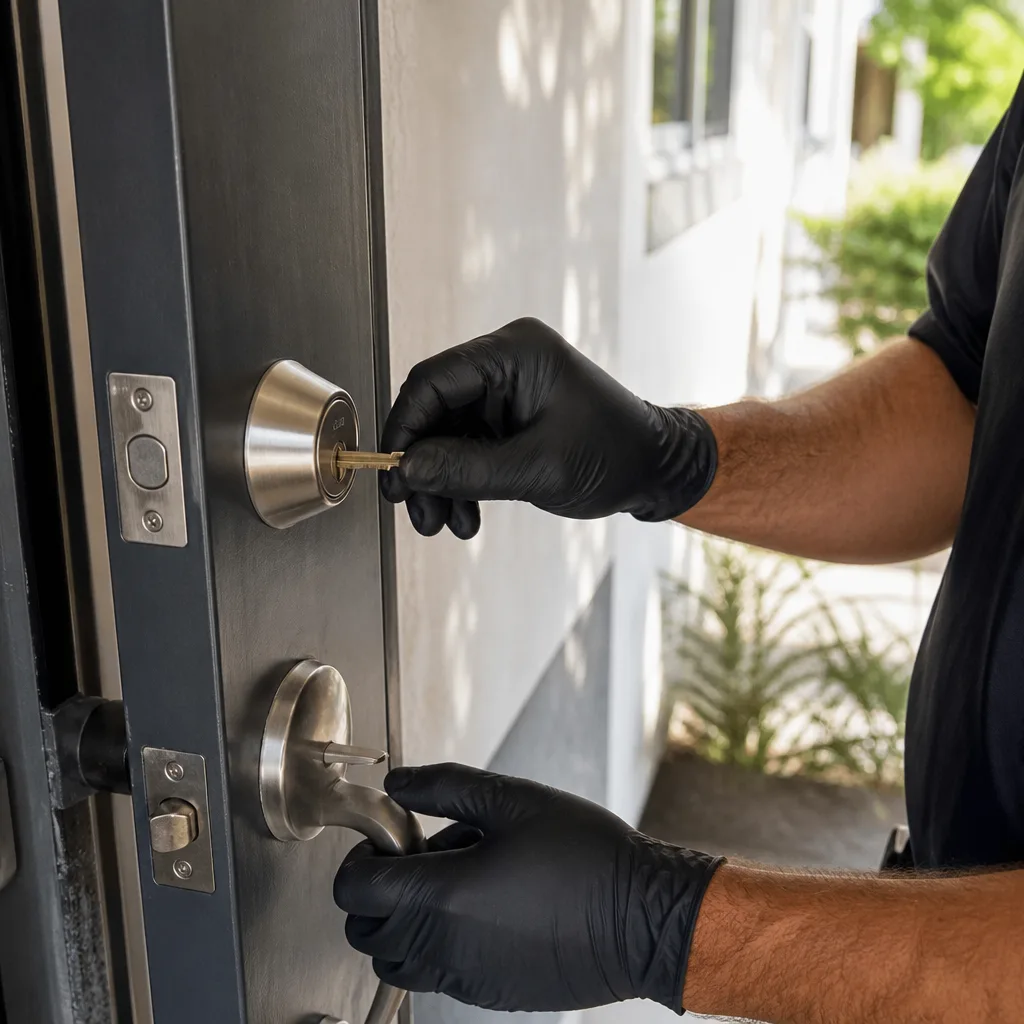 After
AfterResidential Locksmith Warning Signs Every Homeowner Should Know
The locksmith trade in the United States has no federal licensing requirement. Anyone with a drill, a van, and a willingness to answer a phone can call themselves a locksmith. In Los Angeles, where a single Google search for “locksmith near me” surfaces dozens of results, the difference between a legitimate technician and a bait-and-switch operation often comes down to signals you can spot before the work begins. This guide maps those signals: the verbal tells, the visual inconsistencies, and the behavioral patterns that separate a credible professional from a crew that profits by manufacturing emergencies. By the end, you’ll know exactly what to ask, what to verify, and what should make you close the door.
Quick Answer
The clearest our Residential Locksmith services warning signs are: a phone quote that changes when the technician arrives, a company name on the call that doesn’t match the van or invoice, refusal to give a firm price range over the phone, and a technician who immediately declares your lock “broken” and pushes a drill-and-replace job. In California, you can verify any locksmith’s license at bsis.ca.gov before they touch your door. Legitimate Los Angeles locksmiths quote a firm range by job type, confirm the technician’s name and license number before dispatch, and put the price in writing before any work starts.
Table of Contents
- The Phone-to-Door Inconsistency: Call Centers and Name Flipping
- Quote Behavior: Why Refusing to Quote Is the Loudest Red Flag
- The ‘Damaged Lock’ Pivot: Manufacturing Urgency Mid-Job
- California Licensing: What BSIS Actually Requires and How to Verify
- Visual Tells: Vans, Uniforms, and Invoice Headers
- What a Garrison Standard Dispatch Looks Like vs. a Call-Center Dispatch
- The 30-Second Red Flag Checklist
The Phone-to-Door Inconsistency: Call Centers and Name Flipping
The most common residential locksmith scam in Los Angeles starts with a phone call. You search for a locksmith, find a listing that looks local, and call the number. The person who answers says the company name clearly. They quote you a price. They schedule a technician. So far, so ordinary. But here’s what’s actually happening in many of these transactions: the number you dialed belongs to a lead-generation call center, not a locksmith company. That call center sells your job to whoever will take it. The technician who arrives may have never heard of the company name you were given on the phone.
We’ve seen this play out repeatedly in Los Angeles neighborhoods from Silver Lake to Woodland Hills. The call center says “Acme Locksmith.” The van says “Budget Lock & Key.” The invoice has a third name entirely. None of them match. This is called name flipping, and it’s a signature of a call center that brokers jobs rather than performing them. The person stepping out of the van has no accountability to the name you called, because that name belongs to a phone room, not to anyone who fixes locks.
Here’s the tell: when you ask the person on the phone, “What’s the name on the van that will show up at my house?” a legitimate operation answers instantly. A call center hesitates, gives you a name that doesn’t match the listing you found, or says the technician will call you back. A legitimate locksmith has no reason to obscure the connection between the phone, the van, and the invoice. The three should align. If they don’t, hang up and call someone else.
At Ridley Locksmith & Security, the name on the phone is the name on the van is the name on the invoice. We’re part of the Garrison Partners family, and every technician dispatched to a Los Angeles home carries that identity from the first phone call to the final signature. There’s no brokering, no subcontracting, and no mystery about who’s coming through your door.
Quote Behavior: Why Refusing to Quote Is the Loudest Red Flag
A legitimate residential locksmith can give you a firm price range over the phone for most jobs, as we explain in our Seasonal Locksmith Care for Los Angeles: Year-Round Homeowner’s Guide. Rekeying a lock cylinder, installing a new deadbolt, opening a locked door: these are everyday tasks with predictable labor times and standard hardware costs. A technician who has done this work for years knows what a rekey costs. They know what a Schlage deadbolt costs. They know what a Yale smart lock install costs. The range may vary by lock grade and hardware finish, but the range exists.
So when a locksmith refuses to quote any number over the phone, that’s not caution. That’s a pricing structure built on arrival-time pressure. The bait-and-switch model works like this: the phone operator gives a vague, low number or no number at all. The technician arrives, looks at your lock, and starts adding charges. Trip fee. Labor fee. After-hours fee. “This lock is unusual.” “This door needs a different strike plate.” By the time they’re done, the $45 estimate you were given on the phone is a $400 bill, and you’re standing at your own front door with a stranger who has a drill in one hand and a payment terminal in the other. Most people pay. That’s the business model.
We put the written price first precisely because this is the most-reported locksmith complaint in Los Angeles. Every job we take gets a written price before any work begins. That price is the price on the invoice. It’s not an estimate that moves when the technician shows up. If a locksmith won’t commit to a range on the phone, treat that as the red flag it is and end the call.
The ‘Damaged Lock’ Pivot: Manufacturing Urgency Mid-Job
Here’s a scenario we hear about from Los Angeles homeowners with alarming regularity. You called a locksmith for a simple rekey or a lockout. The technician arrives, looks at the lock, and starts shaking their head. “This lock is damaged,” they say. “I can’t rekey it. I’m going to have to drill it out and replace the cylinder. That’s going to be about $300.”
Sometimes the lock is genuinely damaged. Sometimes it isn’t. The problem for the homeowner is that you can’t tell the difference, and the technician knows it. This is the “damaged lock pivot,” and it’s the fraudulent technician’s most effective tool. They manufacture a problem, then sell you the solution at a premium price. The drill comes out. The cylinder is destroyed. Now you can’t put the old lock back even if you wanted to. You’re locked into the replacement. The price climbs.
Here’s how a credible technician handles a damaged lock. They show you the problem before they touch it. They point out the broken spring, the worn pins, the bent keyway. They explain what they’re seeing in plain language, because a confused customer can’t give informed consent. And they give you the replacement price in writing before the drill goes in. A technician who reaches for the drill while you’re still processing the “it’s broken” news is not giving you time to think. That pause should bother you.
We train our technicians to explain the condition of every lock before any work begins. If a lock needs replacement, we say why, we show why, and we put the number on paper. The drill is the last resort, not the first move.
California Licensing: What BSIS Actually Requires and How to Verify
California is one of the states that does regulate locksmiths. The Bureau of Security and Investigative Services, or BSIS, issues a Locksmith License to companies and a Locksmith Employee registration to individual technicians. If someone is working as a locksmith in Los Angeles without a BSIS-issued license or registration, they’re operating illegally. That’s not a technicality. It’s the difference between a background-checked professional and someone who bought a drill at Home Depot and listed themselves on Google Maps.
Here’s the verification process, step by step:
- Ask the person on the phone for the company’s BSIS Locksmith License number. They should be able to give it to you without hesitation.
- Ask for the individual technician’s BSIS registration number. In California, the company license and the employee registration are separate credentials.
- Go to bsis.ca.gov, open the license verification page, and enter both numbers.
- Confirm that the names match the names you were given on the phone. A license number that doesn’t match the company name is a problem.
- When the technician arrives, ask to see their BSIS pocket card. It has their name, photo, and registration number. Check it against what you verified online.
This takes five minutes. It filters out nearly every fraudulent operation, because call-center crews and unlicensed technicians rarely have verifiable BSIS credentials. Every Ridley Locksmith & Security technician carries a valid BSIS registration, and we provide our license information on request before any work begins in Los Angeles. The Garrison Standard requires it. No exceptions.
Visual Tells: Vans, Uniforms, and Invoice Headers
A locksmith’s physical presentation tells you things their phone script won’t. Legitimate locksmith companies in Los Angeles operate marked vans. The van has a company name, a phone number, and usually a license number. The technician wears a uniform with the company name on it. The invoice they hand you matches the van and the uniform. These three surfaces are the company’s face, and a real company keeps them consistent because the brand is the business.
Here are the visual red flags we tell homeowners to watch for:
- An unmarked van. A plain white van with no lettering is the classic bait-and-switch vehicle. There’s no company name to photograph, no number to call, no record of who was there. Legitimate locksmiths with nothing to hide mark their vehicles.
- A magnetic sign slapped on the door. Magnetic signs are cheap and reusable. They pop off. A company that has invested in its vehicles uses permanent lettering. A magnetic sign suggests the van changes identities depending on the day.
- A technician in street clothes. No uniform, no name tag, no company shirt. Ask who they work for. If they mumble, point at the van, or give a different name than the one on the phone, send them away.
- An invoice with no company header. A handwritten receipt with no letterhead, no license number, and no phone number is a receipt from nobody. If something goes wrong, you have no one to call.
- Hardware that’s already out of the box. A technician who shows up with a lock cylinder already assembled and out of its packaging may be installing a used or refurbished part while charging you for new. Ask to see the packaging from brands like Baldwin or Sargent when high-end hardware is specified.
These are all things you can see in the first thirty seconds. You don’t need locksmith knowledge to spot them. You just need to look.
What a Garrison Standard Dispatch Looks Like vs. a Call-Center Dispatch
The Garrison Standard is a set of operating rules that Ridley Locksmith & Security has followed since joining the Garrison Partners family in 2007. Every independently owned and operated location runs by the same code. We say this because the contrast between a Garrison Standard dispatch and a call-center dispatch is one of the clearest ways to understand what accountability looks like in practice.
Here’s what happens when you call Ridley Locksmith & Security for a residential job in Los Angeles:
- You call our number. A live person answers, 24 hours a day, 7 days a week. Not a voicemail, not an answering service, not a call tree that routes you to a call center in another state.
- You describe the job: a rekey, a lockout, a deadbolt install, a high-security cylinder upgrade. We give you a firm price range over the phone, based on the job type.
- Before dispatch, we confirm the technician’s name and BSIS registration number with you. You know who’s coming before they arrive.
- The technician arrives in a marked Ridley Locksmith & Security van, in uniform, and hands you a written price for the full job before any work begins.
- When the work is done, you receive a written guarantee covering the repair for one full year. If it fails inside that year, we come back at no charge. That’s the 365-Day Done Right Promise. It’s not a verbal assurance. It’s a document.
Now compare that to a call-center dispatch. The phone is answered by an operator who reads from a script. They can’t tell you the technician’s name because they don’t know it. They can’t give you a firm price because their job is to get someone to your door, not to quote the work. The technician who shows up is whoever accepted the job. If the work fails, you call the number, get the same call center, and start over. There is no written guarantee, because the call center didn’t do the work and the technician has no relationship to the name you called.
We’re not the cheapest locksmith in Los Angeles. We don’t try to be. We compete on the accountability structure: a written price before work starts, a written guarantee on every repair, background-checked uniformed technicians on every call, and a live person on the phone at 3 a.m. when you’re locked out in Eagle Rock or Mar Vista.
The 30-Second Red Flag Checklist
Here’s the practical version of everything above, condensed into a checklist you can run through while you’re standing on the phone or at your front door. If you hit two or more of these, end the interaction.
On the phone:
- They won’t give a firm price range. Legitimate locksmiths quote by job type. A refusal to quote is a pricing strategy, not a lack of information.
- The company name they give doesn’t match the listing you found. Name flipping starts on the phone. Ask for the exact name that will be on the van and the invoice.
- They can’t provide a California BSIS license number. In Los Angeles, legal locksmith companies carry a BSIS Locksmith License. If they balk, hang up.
- They pressure you to decide now. A legitimate locksmith will hold a time slot for ten minutes while you verify their license. A fraudulent one wants you off the phone before you think.
At the door:
- The van is unmarked or has magnetic signage. No permanent livery is a sign that the company identity is disposable.
- The technician’s name doesn’t match the name you were given on the phone. You should have the technician’s name before dispatch. If the person at the door isn’t that person, close the door.
- They immediately declare your lock “damaged” and reach for a drill. A credible technician shows you the problem, explains it, and gets written approval before drilling.
- The price at the door is higher than the phone quote, without a clear explanation. The price you were given on the phone should be the price on the invoice. Bait-and-switch is the most common locksmith complaint in Los Angeles.
Common Mistakes to Avoid
- Calling the first number that appears on Google Maps without checking anything. Paid listings and spoofed local listings dominate locksmith search results in Los Angeles. Spend three minutes verifying before you dispatch someone to your home.
- Assuming a local area code means a local company. Call-center operations buy local numbers by the dozen. The 323 or 310 area code on the listing doesn’t mean the person answering is anywhere near Los Angeles.
- Letting a technician drill your lock without seeing the written replacement price first. Once the cylinder is drilled, you’ve lost the option to call someone else. The drill is the point of no return. Get the number in writing before the bit touches metal.
- Skipping the BSIS verification. It takes under five minutes at bsis.ca.gov and eliminates nearly all unlicensed operators. Five minutes of verification can save you $300 and a broken door frame.
- Accepting a verbal guarantee. If a technician says “we stand behind our work” but won’t put it in writing, you have no guarantee. A real guarantee is a document with the company’s name, the work performed, and the coverage period.
- Paying cash without a written receipt that includes the company’s license number. Cash transactions with no paper trail are how fraudulent operators stay untraceable. Insist on an itemized invoice before payment.
- Believing that a high-tech-looking website proves legitimacy. A polished website costs a few hundred dollars and takes a weekend to build. It says nothing about licensing, background checks, or accountability.
When to Call a Professional
You need a locksmith when you’re locked out, when you’ve moved into a new home and don’t know who holds copies of the old keys, when a lock is sticking or a key is bending, when you want to upgrade to high-security hardware like Mul-T-Lock or Sargent cylinders, or when you need multiple locks rekeyed to a single key. These are not DIY jobs. A lock that’s installed wrong is a false sense of security, and a drilled-out deadbolt is an expensive lesson. Ridley Locksmith & Security offers free estimates in Los Angeles. Call (956) 275-7388 and a live person will answer. We’ll give you a firm price range by job type, confirm the technician’s name and BSIS registration before dispatch, and put the full price in writing before any work starts. For more on what we do across the city, see our Residential Locksmith in Los Angeles page or learn about Rekey Locks in Los Angeles. Business owners can also review our Commercial Locksmith in Los Angeles work. And if you’re just getting oriented, here’s the Ridley Locksmith & Security home page.
Frequently Asked Questions
Verify their California BSIS Locksmith License at bsis.ca.gov before they touch your lock. Confirm that the company name on the license matches the name on the phone, the van, the uniform, and the invoice. A legitimate Los Angeles locksmith gives you a firm price range over the phone, confirms the technician’s name and registration before dispatch, and puts the full price in writing before work begins. If any of those steps are missing, you’re taking a risk. Call (956) 275-7388 and we’ll walk you through what a verifiable, accountable dispatch looks like.
Because their pricing model depends on getting a technician to your door before revealing the real cost. Once you’re standing at your own front door with a stranger holding a drill, you’re far less likely to refuse a padded invoice. A legitimate locksmith quotes by job type over the phone because rekeys, lockouts, and deadbolt installs have predictable labor and hardware costs. Refusal to quote is a pricing strategy, not a knowledge gap. If they won’t give you a number, call someone who will.
With a legitimate operator, yes. At Ridley Locksmith & Security, the written price we give before any work begins is the price on the invoice. It doesn’t expand on arrival, and there’s no surprise trip fee tacked on at the door. If a technician adds charges after the phone quote without a clear, written explanation, that’s bait-and-switch behavior and it’s the single most common locksmith complaint we hear about from Los Angeles homeowners.
Yes, and it’s not optional. California requires locksmith companies to hold a BSIS Locksmith License and individual technicians to carry BSIS employee registration. Operating without them is illegal. Verification takes five minutes at bsis.ca.gov, and those five minutes are the most effective filter available for separating licensed locksmiths from unlicensed operators. Every Ridley Locksmith & Security technician carries valid BSIS registration and we provide license information on request before dispatch.
A rekey changes the internal pins in an existing lock so the old keys no longer work; the hardware stays in place. A replacement removes the old lock entirely and installs new hardware. Rekeying is almost always cheaper and is the right move when your locks are in good condition but you don’t know who has old keys. Replacement makes sense when the hardware is worn, damaged, or when you’re upgrading to high-security cylinders from lines like Sargent or Baldwin. Read more on our Rekey Locks in Los Angeles page.
Document everything: the invoice, the van’s license plate, the technician’s name if you have it, and the phone number you called. File a complaint with the California Bureau of Security and Investigative Services if the operator was unlicensed or misrepresented their credentials. You can also report the listing to Google. Going forward, run every locksmith through the verification steps in this guide and our more guides & resources before they arrive. The best defense is five minutes of checking before you ever open the door.
The Bottom Line
Residential locksmith fraud in Los Angeles is not about elaborate cons. It’s about exploiting the gap between what a homeowner assumes and what a homeowner verifies. The warning signs are visible on the phone, at the door, and on the invoice. A company name that shifts between the call and the van. A refusal to quote a firm range. A technician who declares your lock broken before explaining anything. An unmarked vehicle, a missing BSIS registration, a price that climbs on arrival. These are all signals you can read in real time. The Garrison Standard exists because those signals matter: a written price before work starts, a written guarantee on every repair, and a technician whose name you know before they ring your bell. Verify first. It’s faster than fixing what goes wrong when you don’t.
Written by Drew Kowalski, Owner at Ridley Locksmith & Security, serving Los Angeles since 2007.