
Last updated October 9, 2026
Non-destructive entry first, always - and we re-key Schlage, Kwikset, and Baldwin locks on the spot while you watch
You get a price before we start. It does not change when we arrive. No surprises.
 Before
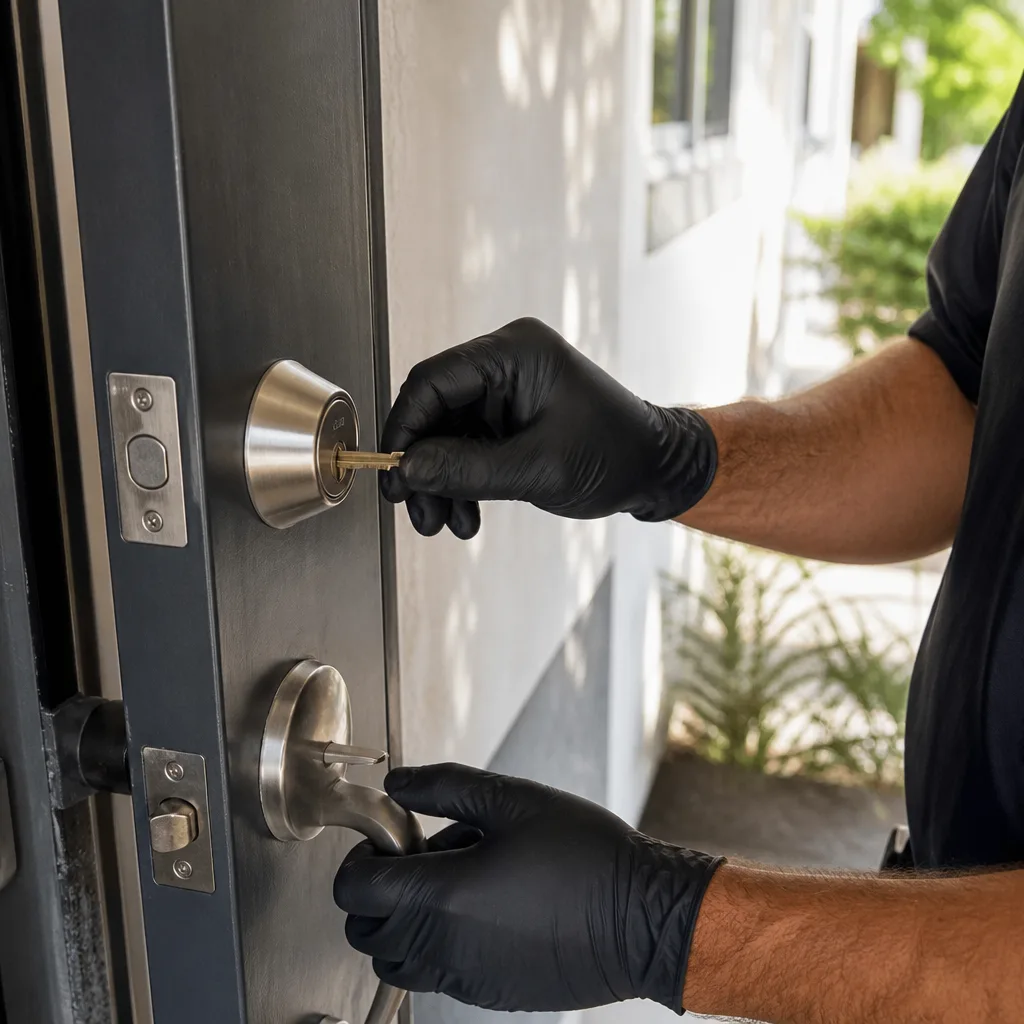 After
AfterHow Long Does Residential Locksmith Take? Timelines and What to Expect
A lockout that should take 10 minutes to open can be stretched to 45. Not because the lock is difficult, but because the billing model rewards slow hands. If you’ve ever stood on a porch in Los Angeles watching a technician fiddle with a Schlage deadbolt while the clock runs, you already understand the problem this guide solves.
We’re going to break down the two timelines every homeowner should track: how long it takes a technician to reach your door, and how long the actual work should take once they’re inside. The first number is easy to find. The second is the one companies never publish, and it’s the one that determines whether you pay a fair price or fund someone’s extended coffee break. By the end, you’ll know exactly what to expect for a lockout, a rekey, a deadbolt replacement, and a full re-hardware job, plus the red flags that signal a technician is padding the clock. For related reading, see our Locksmith Cost Breakdown: The Los Angeles Homeowner’s Reference for 2026.
Quick Answer
A residential locksmith job in Los Angeles typically takes 5 to 90 minutes of actual work once the technician arrives, depending on the job: lockouts run 5 to 15 minutes, rekeying 10 to 20 minutes per cylinder, deadbolt replacement 20 to 40 minutes, and full re-hardware 60 to 90 minutes. Dispatch time, the wait between your call and the technician’s arrival, runs 20 to 45 minutes on average in Los Angeles. The work-time numbers assume a trained technician with the right tools and no upsell detours.
Table of Contents
- The Two Clocks: Dispatch Time vs. Job Time
- Real Time Benchmarks by Job Type
- Why Job Time Can Balloon
- Red Flags That a Technician Is Padding Time
- The Garrison Standard: Pre-Job Confirmation
- Los Angeles Factors That Affect Timelines
- Common Mistakes to Avoid
- When to Call a Professional
- Frequently Asked Questions
The Two Clocks: Dispatch Time vs. Job Time
Most guides conflate two completely different measurements and then wonder why their numbers don’t match reality. Clock one is dispatch time: the minutes between hanging up the phone and the technician knocking on your door. Clock two is job time: the minutes between the first tool touching the lock and the final key test.
Dispatch time in Los Angeles varies by neighborhood, traffic, and time of day. A call from Silver Lake to a technician in Echo Park might run 15 minutes at 2 p.m. and 35 minutes at 6 p.m. A call from Westchester when the nearest available tech is in Culver City pushes toward 45. That’s geography and traffic, not a measure of anyone’s competence.
Job time is where skill and honesty show up. A trained technician working on a standard Kwikset or Schlage lock should move at a predictable pace. The technician knows the pinning pattern, carries the right followers and plug spinners, and doesn’t need to consult YouTube mid-job. When the work goes two or three times longer than benchmark without a visible reason, something else is happening. We’ll cover what that something usually is in a later section.
Why does this distinction matter? Because a company that gets you a fast dispatch time can still bill you for a slow job. You judge the wrong number and overpay. Separate the two clocks, and you can see the pricing model clearly.
Real Time Benchmarks by Job Type
These are the numbers we use internally at Ridley Locksmith & Security, based on what our technicians see across Los Angeles residential work. They assume a standard residential lock in good condition, a technician with the correct tools, and no pre-existing damage discovered mid-job.
1. Lockout Entry: 5 to 15 Minutes
A straightforward lockout on a standard Schlage or Kwikset knob or deadbolt should take under 15 minutes. The technician uses non-destructive methods: a bump key, a pick set, or in some cases an air wedge and long reach tool. On older Los Angeles homes with original Baldwin hardware from the 1940s, entry might take closer to 20 because those cylinders have tighter tolerances, but 15 is the reasonable ceiling for most jobs.
If you hear 45 minutes for a lockout, ask why before the technician starts billing. A legitimate answer involves a high-security cylinder or a damaged keyway. An illegitimate answer involves a technician who gets paid by the hour and wants to make the job look harder than it is.
2. Rekey: 10 to 20 Minutes Per Cylinder
Rekeying means changing the internal pins inside the lock cylinder so the old key stops working, without replacing the hardware itself. A single standard cylinder from Kwikset or Schlage takes 10 to 20 minutes. If you have three locks that all key to the same new key, expect 30 to 60 minutes total.
High-security lines change the math. Medeco cylinders involve angled cuts and interacting pins, which require more patience and a technician certified to work with that hardware. Budget 20 to 30 minutes per Medeco cylinder. If you’re rekeying a house in Los Angeles that uses Medeco throughout, that’s a longer job, and it should be. It’s not padding; it’s precision work.
3. Deadbolt Replacement: 20 to 40 Minutes
Swapping a deadbolt involves removing the existing hardware, preparing the door if the new bolt doesn’t align with the old strike plate, installing the new deadbolt, and testing the throw. On a door that’s already drilled to standard dimensions, 20 to 40 minutes is normal. On an older Los Angeles door with non-standard spacing, the technician may need to chisel or re-drill, which adds time.
4. Full Re-Hardware: 60 to 90 Minutes
Re-hardware means replacing the knob, deadbolt, strike plates, and sometimes the hinges. This is a one-to-one-and-a-half-hour job on a standard door. Two doors, two hours plus. The time goes into alignment, adjusting the strike plate, ensuring the latch doesn’t bind, and making sure the deadbolt throws fully without resistance.
Benchmark Summary
- Lockout entry: 5 to 15 minutes standard, 15 to 20 minutes for high-security or damaged cylinders
- Rekey per cylinder: 10 to 20 minutes standard, 20 to 30 minutes for Medeco or Mul-T-Lock
- Deadbolt replacement: 20 to 40 minutes
- Full re-hardware: 60 to 90 minutes per door
- Smart lock installation: 30 to 60 minutes, depending on whether the existing deadbolt prep matches the smart lock’s footprint
Why Job Time Can Balloon
Sometimes a job legitimately runs long. Sometimes it runs long because of choices made before the technician ever arrived. Knowing the difference protects you from both confusion and exploitation.
Legitimate Reasons for Longer Jobs
- High-security cylinders: Medeco, Mul-T-Lock, and Abloy cylinders use complex pinning systems that resist picking, bumping, and forced entry. That’s the point of buying them, and it means rekeying or servicing takes longer. A technician certified on those lines works faster than one who isn’t, but it’s still more time than a Kwikset cylinder.
- Damaged keyways: A key that broke off inside the cylinder, a keyway that’s been attacked with a screwdriver, or a lock that’s been corroded by coastal air near Santa Monica or Long Beach all add time. The technician has to extract, clean, or repair before any actual locking work begins.
- Older door prep: Los Angeles housing stock runs from 1910 craftsman bungalows in Highland Park to 2005 tract homes in Porter Ranch. Older doors often have non-standard bore holes, stripped screw holes, or settled frames that throw off alignment. Every adjustment adds minutes.
- Hardware compatibility: Not every deadbolt fits every door. If you bought a Baldwin deadbolt online and it doesn’t match the existing door prep, the technician either modifies the door or you exchange the hardware. Either way, the clock runs.
The Stall-and-Inflate Playbook
Now the less pleasant reasons. Some technicians stretch a 15-minute rekey into a 45-minute transaction through a sequence of small delays: repeated ‘test’ cycles with the same key, disassembly narration that sounds informative but really just burns minutes, mid-job discovery of ‘damage’ that wasn’t mentioned during the initial quote, and the classic ‘I need to run back to the van for a different tool’ that loops twice.
Each interruption adds five or ten minutes. The final invoice claims the job required extra labor. This is the model that rewards slow hands. The fix is to ask for a written price before work starts, which locks the quote regardless of how long the job takes within reasonable limits. See How to Hire a Locksmith Contractor in Los Angeles: A Step-by-Step Guide for the full vetting checklist.
Red Flags That a Technician Is Padding Time
You don’t need locksmith training to spot stall tactics. You need to know what normal looks like and what manufactured delay looks like. Here are the patterns we tell our own technicians never to replicate, because they burn trust with customers in a city that already has a healthy skepticism of service providers.
- The never-ending test cycle: The technician inserts the key, turns it, removes it, and repeats this ten times while narrating each step. One test confirms the rekey worked. Two tests confirm it works in both directions. Ten tests is a show.
- The disappearing tool run: A prepared technician arrives with a kit that covers standard residential brands. If your Kwikset lock requires a ‘special tool’ that’s in the van, the van might as well be in another county. This buys five or ten minutes per round trip.
- The mystery damage reveal: The technician starts the job, then stops to announce that your cylinder is ‘worn out,’ ‘damaged,’ or ‘about to fail.’ Sometimes this is true. More often it’s the setup for an upsell. Ask to see the damage. A worn cylinder shows visible pins or scoring; a manufactured crisis shows nothing.
- The disassembly lecture: Explaining how a lock works takes two minutes. Explaining it for twenty minutes while the lock sits disassembled on the table is not education; it’s billable theater.
- The sudden complexity upgrade: ‘This is actually a high-security situation’ after ten minutes on the job, when the lock is a standard Yale knob the technician hasn’t managed to open yet. If it was a standard job at quote time, it’s a standard job at minute ten.
The Garrison Standard: Pre-Job Confirmation
At Ridley Locksmith & Security, part of the Garrison Partners family, every technician operates under The Garrison Standard. That’s not a slogan. It’s a written code that dictates how jobs are quoted, performed, and guaranteed. One of its requirements is directly relevant to the timeline question: before any work begins, the technician states the expected duration in plain terms and confirms the written price.
That means you know before the first tool touches the lock that a rekey should take 15 minutes per cylinder, that a deadbolt replacement runs about 30, and that the price on the written quote is the price on the invoice regardless of whether the job runs ten minutes over. We also carry a written guarantee on every job: the 365-Day Done Right Promise. If the work fails within one full year, we return and make it right at no charge. That guarantee applies to every repair we do in Los Angeles, whether it’s a rekey in Echo Park or a full re-hardware in Sherman Oaks.
Drew Kowalski, our owner, set that standard when the company joined Garrison Partners in 2007. Every technician is background-checked, uniformed, and dispatched directly by us, not subcontracted to a call center that sends whoever’s closest. A live person answers our phone 24 hours a day, seven days a week. When you call, you talk to someone who can give you honest timeline expectations, not a scripted operator reading from a national playbook.
Los Angeles Factors That Affect Timelines
Every city has market realities that shape locksmith timelines, and Los Angeles has a few that visitors and new arrivals don’t always anticipate.
Traffic is the obvious one. A technician dispatched from our central Los Angeles operation might reach Silver Lake in 15 minutes or 45, depending on the 101. During weekday peak hours, add a realistic buffer. We quote dispatch windows honestly rather than promising a 20-minute guarantee that no one can actually deliver on the 405 at 5:30 p.m.
Housing stock variety matters more than people expect. Los Angeles has everything from 1920s Spanish revival homes with original hardware to mid-century apartment buildings with locks that haven’t been serviced since the Nixon administration. Older hardware often needs longer service times, not because the technician is slow but because the lock hasn’t been maintained in decades. A 1930s Baldwin mortise lock in a Hancock Park home is a different job than a Kwikset deadbolt in a 2015 build in Playa Vista.
Coastal corrosion is a real variable. Homes within a few miles of the coast in Venice, Santa Monica, and San Pedro deal with salt air that corrodes lock internals faster than inland areas. The cylinder tightens, the springs degrade, and entry or rekey work takes longer because the technician has to clean or lubricate internal components before doing the actual job.
Permit considerations for commercial-adjacent work. Most residential locksmith work in Los Angeles requires no permit. But if you’re in a multi-unit building governed by an HOA, some associations have keying policies that require management notification before any lock change. That’s a scheduling variable, not a work-time variable, but it can delay the start of a job.
For a fuller picture of what residential work involves in this city, see our guide to residential locksmith services in Los Angeles.
Common Mistakes to Avoid
- Calling a national call center instead of a local shop. National services dispatch a subcontractor who may be 45 minutes away, unfamiliar with Los Angeles housing stock, and incentivized to upsell. A locally operated company like ours has technicians who have worked Los Angeles doors for years and know what a 1935 cylinder versus a 2015 cylinder requires.
- Accepting a verbal estimate. A price quoted over the phone can shift at the door. A written price, confirmed before work begins, cannot. Demand the document.
- Not asking how long the job should take. If the technician can’t give you a benchmark, that’s information. If they give you one and then double it without explanation, ask why.
- Buying hardware without checking fit. A deadbolt that doesn’t match your existing door prep converts a 30-minute swap into a 90-minute door modification. Check compatibility before you buy, or let the technician supply the hardware.
- Ignoring lock maintenance until it fails. A lock that’s sticky now will be inoperable next year. Annual inspection and minor servicing beats an emergency lockout at midnight, when your options are narrower and your leverage is nil.
- Assuming all lockout jobs require drilling. A skilled technician can open most standard residential locks without destructive entry. If the first suggestion is to drill the lock, get a second opinion before you pay for a replacement you might not need.
- Rushing a rekey after a move-in. Los Angeles renters and buyers often move fast, but a rekey done wrong means old keys still work. Give the technician the 15 minutes per cylinder the job actually requires rather than hurrying them through.
When to Call a Professional
Some locksmith work is safe to attempt yourself. Installing a basic Kwikset smart lock with matching prep is a 20-minute DIY job if you’re comfortable with a screwdriver. But any situation involving a broken key extraction, a lock that won’t turn, a high-security cylinder, or a door that no longer latches properly deserves a trained technician. Forced entry attempts or improvised tools damage the door and often cost more to repair than the original service would have cost.
Ridley Locksmith & Security offers free estimates in Los Angeles. Call (956) 275-7388, tell us what you’re dealing with, and we’ll give you a timeline and a written price before anyone is dispatched. For rekeying specifically, our technicians follow the same benchmarking and pricing standards outlined here. Learn more about our rekey services in Los Angeles.
Frequently Asked Questions
A standard residential job takes 5 to 90 minutes of on-site work once the technician arrives, depending on the type of work. Lockouts run 5 to 15 minutes, rekeying 10 to 20 minutes per cylinder, deadbolt replacement 20 to 40 minutes, and full re-hardware 60 to 90 minutes. Dispatch time adds another 20 to 45 minutes in Los Angeles depending on traffic and your location. Call (956) 275-7388 for an exact timeline for your specific job, with a written price confirmed before work starts.
Dispatch times in Los Angeles typically run 20 to 45 minutes, varying by neighborhood and traffic. A job near our central Los Angeles operation might see a technician in 20 minutes during off-peak hours, while a call from the Westside during rush hour could push toward 45. We quote realistic windows rather than promising impossible response times, and a live person answers our phone 24 hours a day to give you an honest ETA when you call (956) 275-7388.
At Ridley Locksmith & Security, the written price delivered before any work begins is the price on the invoice, full stop. We don’t add a call-out surcharge on arrival, and we don’t revise the price mid-job unless you approve additional work in writing first. This is part of The Garrison Standard that every technician operates under. If a company won’t put the price in writing before touching your lock, call someone else.
Rekeying a standard single-cylinder lock takes 10 to 20 minutes per cylinder, so a typical three-lock house in Los Angeles runs 30 to 60 minutes. High-security cylinders from Medeco or Mul-T-Lock take longer, around 20 to 30 minutes per cylinder, because of their complex pinning systems. Rekeying changes the lock’s internal pins so old keys no longer work, without replacing the hardware itself. Call (956) 275-7388 for a written price on rekeying your specific locks.
No. A trained technician can open most standard residential locks in Los Angeles without drilling, using non-destructive methods like picking or bumping. Drilling is a last resort for severely damaged cylinders, high-security locks that have failed internally, or keyways blocked by broken key fragments. If a technician suggests drilling within the first few minutes without explaining why, ask for a second opinion before you pay for a replacement lock.
Ask three questions: What’s the written price before you touch the lock? How long should this job take? Are you licensed and insured? A legitimate professional answers all three directly, without hedging. At Ridley Locksmith & Security, every technician provides a written price, states the expected duration, and is background-checked, uniformed, and dispatched directly by us, not a subcontractor. Call (956) 275-7388 and ask us anything.
Yes. Every job carries the 365-Day Done Right Promise: a written guarantee covering the repair for one full year. If the work fails inside that window, we return and make it right at no charge. The second visit is free, included automatically. That guarantee covers every residential job we do in Los Angeles, from a single rekey in Koreatown to a full re-hardware in Brentwood.
The Bottom Line
A residential locksmith job in Los Angeles should take 5 to 90 minutes of actual work depending on the job, with dispatch adding 20 to 45 minutes on top. The number most homeowners don’t track is the job-work clock, and that’s where overbilling hides. Know your benchmarks: 5 to 15 minutes for a lockout, 10 to 20 per cylinder for a rekey, 20 to 40 for a deadbolt swap, 60 to 90 for full re-hardware. Demand a written price before work begins. Watch for stall tactics. And if you want a technician who states the expected duration before billing starts, not after, call Ridley Locksmith & Security at (956) 275-7388. Our Ridley Locksmith & Security home page has more on how we operate, and our commercial locksmith services in Los Angeles follow the same written-price and written-guarantee standard.
Written by Drew Kowalski, Owner at Ridley Locksmith & Security, serving Los Angeles since 2007.