
Last updated October 9, 2026
Non-destructive entry first, always - and we re-key Schlage, Kwikset, and Baldwin locks on the spot while you watch
You get a price before we start. It does not change when we arrive. No surprises.
 Before
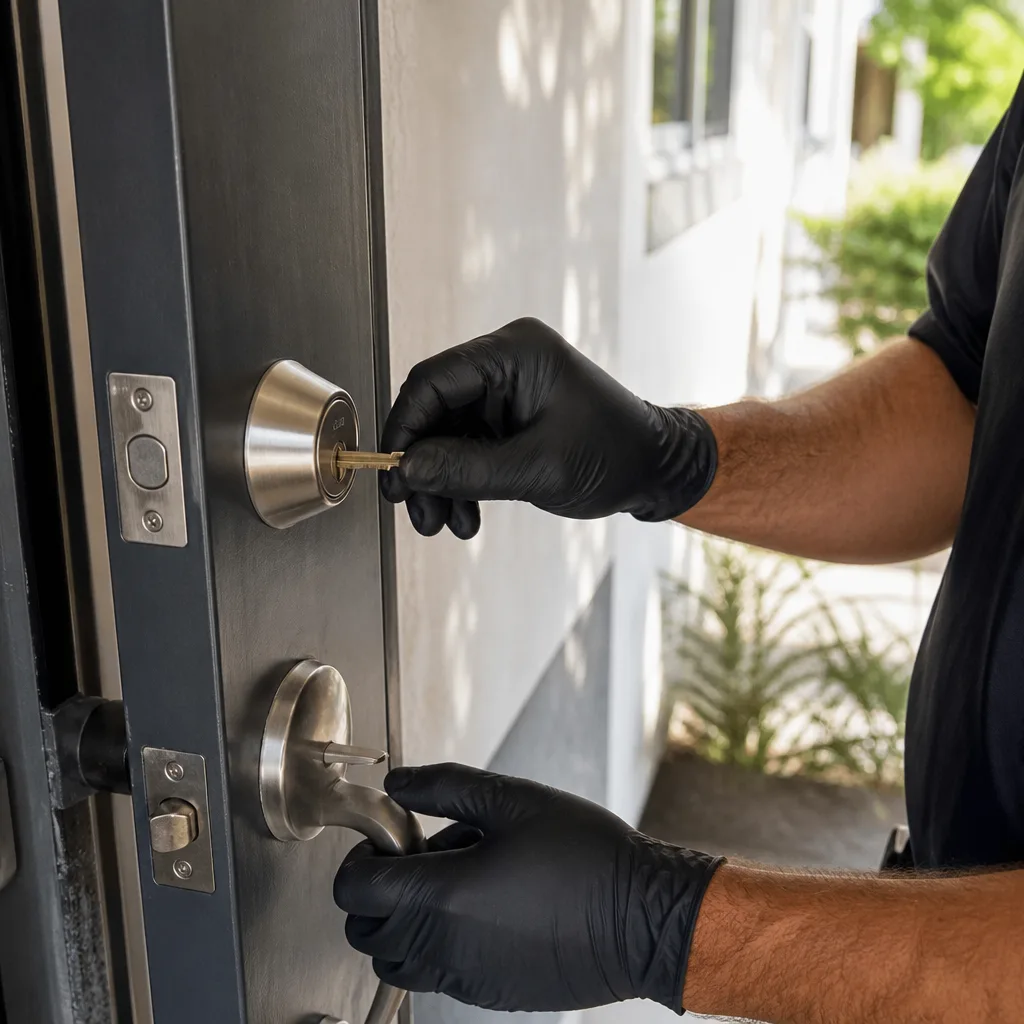 After
AfterHow Long Does Commercial Locksmith Take? Timelines and What to Expect
A 10-door commercial rekey sounds like an afternoon of work. But if it’s a master key system with a bitting record that hasn’t been maintained, it can become a two-day project that the contractor could have flagged on day one. The honest answer to “how long does commercial locksmith take” is that it depends on variables most building managers never think to ask about. This guide gives you the benchmarks to run an informed job, whether you’re managing a retail storefront in Los Angeles, a medical office off Wilshire, or a warehouse in Vernon.
Quick Answer
Most single-door commercial locksmith jobs in Los Angeles take 15 to 45 minutes once the technician is on site. Multi-door rekeys, master key system work, and access control installations run from 2 hours to a full day or more. The exact time hinges on door count, hardware grade, master key complexity, and the condition of the existing hardware, not just the job type.
Table of Contents
- Time Benchmarks by Job Type
- The Master Key Multiplier
- Scope Creep in Commercial Jobs
- Los Angeles Building Factors That Add Time
- How to Structure the Job Conversation
- The Garrison Standard Job Confirmation Process
- Common Mistakes to Avoid
- When to Call a Professional
- Frequently Asked Questions
- The Bottom Line
Time Benchmarks by Job Type
Every commercial locksmith job has a realistic time range. The ranges below reflect what our technicians at Ridley Locksmith & Security home actually see in the field across Los Angeles commercial properties. These assume standard hardware in functional condition. Add time for anything unusual.
Single-Door Commercial Lockout: 10 to 20 Minutes
A simple lockout on a standard commercial door takes 10 to 20 minutes once the technician arrives. The method depends on the lock type. Cylindrical locks and mortise locks pick differently, and some storefront doors require latch manipulation rather than picking. Non-destructive entry is the goal on nearly every call. If the door has a high-security cylinder from Medeco or Mul-T-Lock, picking becomes impractical, and the technician will need to drill and replace the cylinder, which adds 20 to 30 minutes and the cost of new hardware.
Standard Cylinder Rekey: 15 to 25 Minutes Per Cylinder
Rekeying a standard commercial cylinder means removing the cylinder, replacing the internal pins so old keys stop working, and reinstalling it. A single cylinder on a Schlage or Kwikset commercial lockset takes 15 to 25 minutes. Ten standard cylinders on a simple storefront, no master key involved, should run 2.5 to 4 hours. The per-cylinder time compounds quickly when a building has 30 or 40 doors, which is why many Los Angeles building managers schedule rekeys in phases rather than trying to complete an entire property in one visit.
Master Key System Rekey: Variable, Often 1 to 2 Days
A master key system rekey is a different animal entirely. The time depends on whether the system has a maintained bitting record, which is the document that tracks how every key and cylinder interacts. If the record exists and is current, a 20-cylinder master system rekey with multiple access levels can take 4 to 8 hours. If the record is missing or outdated, the technician must reverse-engineer the keying chart by disassembling cylinders and charting pins, which can push the job to two full days. This is the single biggest variable in commercial locksmith timelines.
Access Control Panel Install: 2 to 4 Hours Per Door
Installing an access control panel on an existing door takes 2 to 4 hours per door. The work includes mounting the reader, running low-voltage wiring, installing the electric strike or magnetic lock, configuring the panel, and testing credentials. Older Los Angeles buildings with solid concrete walls or no existing conduit can extend this significantly. A four-door access control retrofit in a downtown LA office building routinely runs a full day or more.
Panic Hardware Replacement: 45 to 90 Minutes Per Door
Replacing a panic bar, also called an exit device, takes 45 to 90 minutes per door. The time covers removing the old device, verifying the door prep matches the new hardware, installing the bar, and testing exit function. Doors with non-standard prep dimensions, common in pre-1970s commercial buildings in Los Angeles, require additional modification time. Fire-rated doors add a compliance check, since the panic hardware must meet specific release requirements.
High-Security Cylinder Installation: 30 to 60 Minutes Per Cylinder
Installing a high-security cylinder from a manufacturer like Medeco or Abloy takes 30 to 60 minutes per cylinder. The additional time versus a standard cylinder comes from the restricted keyway and the need to register keys with the manufacturer. Some high-security systems require the technician to file paperwork with the lock manufacturer before the cylinder is even functional, which adds administrative time that doesn’t show up on the invoice as field labor but does extend the overall project window.
The Master Key Multiplier
Here’s the concept that separates an informed building manager from one who gets surprised by a timeline. A master key system with 20 cylinders does not take 20 times the per-cylinder rekey time. It takes disproportionately longer. The reason is structural.
In a standard rekey, each cylinder is independent. You rekey cylinder one, move to cylinder two, and nothing connects them. In a master key system, every cylinder shares a mathematical relationship with every other cylinder. A change key must operate only its designated cylinder. A master key must operate all of them. A sub-master might operate a floor, and a grand master might operate the entire building.
- Charting time. Before any cylinder is touched, the technician must establish or verify the keying chart. This is the map of which key operates which cylinder at which level. A missing or outdated chart means reverse-engineering, which can take hours on its own.
- Pin calculation. Every cylinder in a master system uses additional master pins stacked in the pin chambers. The technician must calculate the correct pin stack for each cylinder so that multiple keys function at their intended levels without creating cross-keying, where a change key accidentally operates a cylinder it shouldn’t.
- Sequential removal. In a commercial building, you can’t remove all 20 cylinders and take them to a bench. Doors need to stay secured. The technician works in manageable batches, rekeying a few cylinders at a time while keeping the building lockable, which adds travel time between doors and back-and-forth verification.
- Key cutting and testing. After the cylinders are repinned, every key level must be cut and tested against every cylinder in its access group. This testing phase alone can take an hour on a 20-cylinder system.
A well-maintained 20-cylinder master system rekeyed by an experienced commercial locksmith with the bitting record in hand might take 4 to 6 hours. The same system with no record, three access levels, and mixed hardware grades can stretch to two days. When a contractor quotes you a master system rekey at the same flat rate per cylinder as a standard rekey, that’s a red flag. They either don’t understand the system or they’re planning to cut corners on charting and testing.
Scope Creep in Commercial Jobs
Scope creep is the polite name for what happens when a two-hour job becomes a six-hour job because nobody looked at the hardware before quoting. In commercial locksmith work, scope creep comes from three main sources.
Hardware condition surprises. A door that looks fine from the outside can have a corroded cylinder, stripped mounting screws, or a misaligned strike plate once the technician opens it up. Commercial doors in food service environments near the coast, like restaurants in Santa Monica or Long Beach, face salt air corrosion that shortens hardware lifespan. A rekey that should take 20 minutes becomes a cylinder replacement and door alignment job that takes 90 minutes.
Non-standard prep dimensions. Older Los Angeles commercial buildings, especially those built before the 1970s, often have door preps that don’t match modern hardware. A mortise lock body from a defunct manufacturer might have a faceplate dimension that no current product matches. The technician must either modify the door or source a retrofit kit, both of which add time. Buildings in the downtown Los Angeles Historic Core are notorious for this.
Code compliance discoveries. A commercial property that hasn’t had a locksmith inspection in years may have fire code violations hiding in plain sight. Doors that need to swing freely for egress but have been fitted with double-cylinder deadbolts, panic hardware that doesn’t release properly, or latch guards that interfere with exit function. California fire code governs commercial egress in Los Angeles, and a responsible locksmith will flag these issues rather than silently working around them.
The professional response to scope creep is to quote contingencies upfront. A written scope from a competent commercial locksmith includes line items for possible hardware replacement beyond the initial rekey. That’s how you avoid the worst-case scenario: a technician who starts a job, discovers three corroded cylinders, and then hits you with a revised price mid-project.
Los Angeles Building Factors That Add Time
Los Angeles is not one building stock. It’s several generations of construction overlapping in a single city, and the generation of your building directly affects locksmith timelines.
Pre-war downtown buildings in the Historic Core and along Broadway often have original mortise locksets from manufacturers that no longer exist. Some have been retrofitted multiple times, leaving layered modifications that a technician must work through. A simple rekey on one of these doors takes longer because the cylinder may be buried under decades of paint, or the lock body may have been repaired with non-standard parts.
Mid-century commercial strips along corridors like Ventura Boulevard in the Valley or Pico Boulevard on the Westside tend to have aluminum storefront doors with narrow stile locks. These are faster to work on when they’re standard, but the aluminum channels corrode over time, and the lock body can seize into the frame, requiring careful extraction that adds 15 to 30 minutes per door.
Tilt-up concrete warehouses in Vernon, Commerce, and the industrial areas near the 710 freeway usually have steel doors with Grade 1 cylindrical locks. These are straightforward, but the scale of the buildings means more doors per property and more walking time between them. A 40-door warehouse rekey is an all-day job even with standard hardware.
Healthcare and lab facilities across Los Angeles add a compliance layer. Pharmaceutical storage rooms, patient record areas, and controlled substance cabinets may require restricted keyways or specific hardware grades under facility policy or regulation. The locksmith work itself doesn’t take longer, but the documentation and verification steps do.
Climate Factors That Affect Hardware Condition
Los Angeles has a mild climate compared to most of the country, but it’s not uniform. Coastal areas from Malibu down through the South Bay have salt air that accelerates corrosion on exposed hardware. Inland areas like the San Fernando Valley deal with fine dust that works its way into lock bodies. Both conditions mean the technician is more likely to find internal wear and tear that requires cleaning or replacement beyond the basic job scope, and that adds time.
How to Structure the Job Conversation
The difference between a commercial locksmith job that runs on schedule and one that spirals starts with the phone call. Here’s the structure that gets you a realistic timeline before anyone sets foot on your property.
- Describe the door count and hardware type. Don’t say “I need my building rekeyed.” Say “I have 23 doors, mostly Schlage cylindrical locks, two mortise locks on the main entrance, and one panic bar on the back exit.” This tells the locksmith whether they’re sending one technician or two, and whether they need to bring specialized tools.
- Ask about master key status directly. “Is there a master key on this system, and do we have the bitting record?” If the answer to either is unclear, expect the locksmith to build in discovery time. A professional will tell you this upfront. A call center will quote you a flat rate and figure it out later.
- Request a written scope with a time estimate before work starts. Not an estimate after the fact. A written scope lists the doors, the work per door, the contingency items, and the time range. This document is your accountability tool. If the technician arrives and the door count is different, the written scope is the reference point for the conversation that follows.
- Ask about contingency pricing for hardware condition issues. “If you find corroded cylinders, what does the replacement cost per cylinder?” A professional gives you a per-unit price for common contingencies. This prevents the mid-job surprise.
- Confirm who is coming. Ask whether the technician is an employee of the company you’re calling or a subcontractor. In Los Angeles, commercial locksmith dispatch through national call centers often routes to independent operators who have no relationship with the company whose name is on the van. You want to know whose face is going to be at your door.
This conversation takes ten minutes. It saves hours on the back end.
The Garrison Standard Job Confirmation Process
Every commercial job dispatched by Ridley Locksmith & Security operates under The Garrison Standard, the operating code that’s been in place since 2007 as part of the Garrison Partners family. Before work starts on a multi-point commercial job, our technician states the scope back to the customer. This isn’t a formality. It’s the moment where ambiguity dies.
The confirmation covers four things: the door count and job type as the customer described them, the time range for completion, the written price that applies to that scope, and the contingency items that might change the price if discovered during the work. The written price is delivered before any tool touches a lock. It is the price on the invoice, not a teaser that inflates when the technician is already on site.
Our technicians are background-checked and uniformed. They carry identification that connects them to The Garrison Standard. When a technician tells you the scope, the time range, and the price, they’re stating the terms of the job under a standard that has a defined accountability structure behind it. The 365-Day Done Right Promise applies to every commercial repair we perform. If the work fails within one full year, we come back and make it right at no charge. The guarantee is a written document, not a verbal assurance.
This matters for timelines because it eliminates the two biggest sources of delay in commercial locksmith work: a technician who realizes mid-job they need parts or help, and a customer who discovers after the fact that the work wasn’t done correctly. The confirmation conversation forces the scope to be real before the clock starts.
Common Mistakes to Avoid
- Asking “how much per lock” without giving the door count. A flat per-lock price assumes every lock is the same. In a commercial building, they rarely are. Mortise locks cost more to rekey than cylindrical locks, and panic hardware is a different job entirely. Share the actual hardware mix and you’ll get a realistic number instead of a sales figure.
- Waiting until an employee leaves to change the locks. Commercial rekeys in Los Angeles spike after terminations, and for good reason. But the building manager who waits until the employee is already gone is now scrambling. Schedule the rekey the same week you know a termination is coming, and you’ll have the time to do it properly rather than paying for emergency dispatch.
- Treating a master key system like a standard rekey. If you tell a locksmith “I need 20 locks rekeyed” and leave out that it’s a three-level master system, any timeline they give you is fiction. Lead with the master key status.
- Skipping the written scope. A verbal agreement on time and price is worth the paper it’s printed on. In Los Angeles commercial locksmith work, the written scope is the difference between a job that runs as quoted and a dispute you can’t win because neither side documented the terms.
- Assuming the cheapest quote comes from the same job. A lower quote often means contingency items are excluded, meaning the price will move when the technician finds what the other company already planned for. Accountability costs slightly more upfront and dramatically less at the end.
- Not asking whether the technician is an employee or a subcontractor. National call centers dispatch independent operators in Los Angeles who may never have seen the inside of a training program. The company name on the phone call and the person at your door can be different legal entities. Ask directly.
- Ignoring exit devices during a rekey. A common mistake is rekeying only the entrance doors and forgetting the panic hardware on rear exits. A commercial rekey should cover every lockable opening, including storage rooms, roof hatches, and server closets. Missing one means the old key still works somewhere in the building.
When to Call a Professional
Any locksmith work on a commercial property involving master keys, access control, panic hardware, or high-security cylinders from manufacturers like Medeco or Abloy is professional territory. The stakes are too high for improvisation. A commercial lockout during business hours needs a fast response. A terminated employee with a master key is a security event, not a maintenance task. A fire door with failing panic hardware is a code violation waiting to be discovered. Commercial Locksmith in Los Angeles work requires training on hardware that standard Residential Locksmith in Los Angeles technicians never touch. If your building has a master key system and you can’t locate the bitting record, a Rekey Locks in Los Angeles professional can reverse-engineer the system and rebuild it correctly. Ridley Locksmith & Security offers free estimates in Los Angeles. Call (956) 275-7388 and a live person answers, 24 hours a day, 7 days a week.
Frequently Asked Questions
How much will a commercial locksmith actually cost in Los Angeles?
A standard commercial cylinder rekey in Los Angeles typically runs $25 to $45 per cylinder, with a service call fee of $65 to $95 depending on location and time of day. Master key system rekeys run $45 to $75 per cylinder due to the additional pinning and charting work. Panic hardware replacement runs $300 to $700 per door including hardware. Access control installation runs $800 to $2,500 per door depending on the system. These ranges reflect what we see across Los Angeles commercial properties, from storefronts in Silver Lake to office suites in Glendale. Call (956) 275-7388 for an exact written quote, free of charge.
Is the price you quote on the phone the final price?
The written price we deliver before work starts is the price on the invoice. We state the scope, the price, and the contingency items before any tool touches a lock. If the technician finds a hardware condition that wasn’t part of the original scope, it’s discussed and priced before additional work proceeds. No surprises at the door, no price movement after the fact.
How fast can a commercial locksmith get here?
For genuine lockouts and security emergencies, our response time in Los Angeles runs 30 to 60 minutes across most of the metro area. Non-emergency commercial work like planned rekeys and access control installations is scheduled at your convenience, often same day or next day depending on the scope. Every call is answered by a live person, 24 hours a day, 7 days a week, and you’ll get a real response window rather than a vague promise.
How do I know the locksmith I hire is legitimate?
Ask three questions: Are you licensed and insured? Are your technicians employees or subcontractors? Will you provide a written price before work starts? A legitimate commercial locksmith answers all three without hesitation. Ridley Locksmith & Security has been part of the Garrison Partners family since 2007, operating under The Garrison Standard, which sets defined accountability requirements for every technician we dispatch.
Do commercial locksmiths in Los Angeles work nights and weekends?
Yes, but the pricing structure changes. Emergency night and weekend dispatch carries a higher service call fee than standard business hours. For planned commercial work, scheduling during regular hours keeps costs down and gives the technician full access to the building without after-hours security protocols. For true emergencies, we’re available around the clock. Call (956) 275-7388 any hour and you’ll speak to a live person who can give you an honest arrival window.
Should I rekey or replace my commercial locks?
Rekeying is the right call when the hardware is in good condition and you want to invalidate old keys without spending on new hardware. Replacement is the right call when the hardware is damaged, corroded, or you’re moving to high-security cylinders from brands like Medeco or Mul-T-Lock that require new lock bodies. The decision affects both cost and timeline. A rekey is faster. A replacement is a longer job but resets the hardware lifespan. A written scope will spell out which doors need which treatment.
The Bottom Line
Commercial locksmith timelines in Los Angeles range from 10 minutes for a simple lockout to two full days for a master key system rekey with no maintained records. The variable isn’t the locksmith. It’s the building: door count, hardware grade, master key complexity, age of the structure, and condition of the existing hardware. Building managers who describe their property accurately on the first call, request a written scope with a time estimate, and ask about contingency pricing are the ones whose projects run on schedule. The ones who ask for a flat per-lock price and hope for the best are the ones who end up surprised. Know your building, know your hardware, and hold your contractor to a written standard before the clock starts.
Written by Drew Kowalski, Owner at Ridley Locksmith & Security, serving Los Angeles since 2007.