
Last updated October 9, 2026
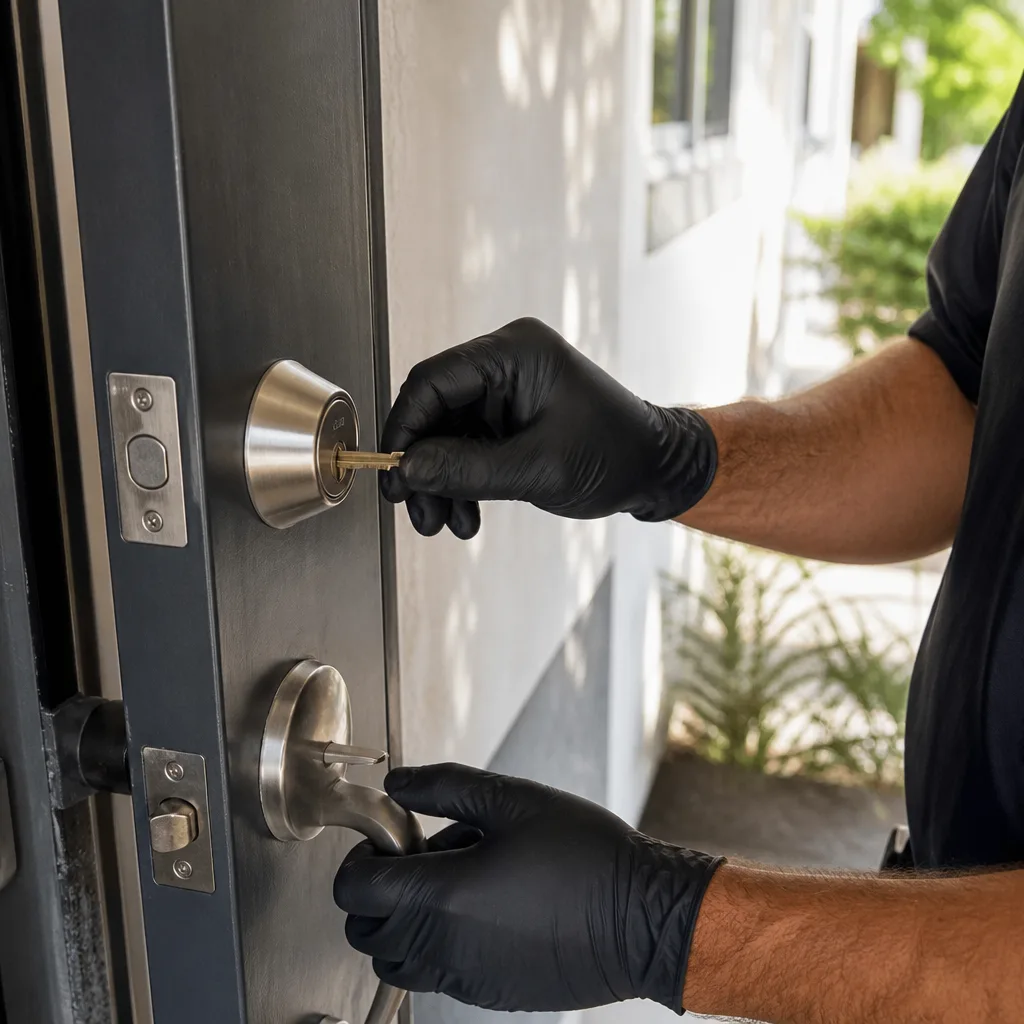
Non-destructive entry first, always - and we re-key Schlage, Kwikset, and Baldwin locks on the spot while you watch
You get a price before we start. It does not change when we arrive. No surprises.
 Before
 After
AfterCommercial Locksmith Warning Signs Every Homeowner Should Know
A locksmith who walks through your facility and recommends replacing your entire master key system before testing whether a rekey solves the problem is not protecting your building. They’re protecting their invoice. Commercial locksmith fraud operates on a bigger scale than residential scams, because the jobs are larger, the hardware is more specialized, and the person signing the check often isn’t the person who uses the keys. In Los Angeles, where commercial properties range from Highland Park storefronts to downtown office towers, the gap between a legitimate security upgrade and a commission-driven upsell can be five figures wide. This guide teaches you how to spot the difference before you sign a work order.
Quick Answer
The clearest warning signs of a bad commercial locksmith are a quote that pushes full system replacement before diagnosing the actual problem, a flat “system fee” with no per-door or per-cylinder breakdown, refusal to show a California BSIS locksmith license or CSLB C-28 contractor credential, and no written key control record after the job. A trustworthy commercial locksmith in Los Angeles itemizes the work, verifies credentials in writing, and documents every cylinder changed. In Los Angeles, you can verify both licenses online in under three minutes, and you should, every time.
Table of Contents
- The System-Replacement Pitch: Upgrade or Upsell?
- Quote Structure as a Credibility Signal
- License Verification for Commercial Work in California
- Subcontractor Disclosure: Who Is Actually Doing the Work?
- Post-Job Documentation: The Paper Trail You Should Demand
- A Red-Flag Checklist for Los Angeles Commercial Properties
- Common Mistakes to Avoid
- When to Call a Professional
- Frequently Asked Questions
- The Bottom Line
The System-Replacement Pitch: Upgrade or Upsell?
Here’s the scenario we hear most often from Los Angeles business owners: a key stops working, a lock feels loose, or an employee quits without returning a key. They call a locksmith. The technician spends ten minutes looking at the hardware and then delivers a recommendation: the entire master key system needs replacement. The quote lands at $4,000, $6,000, sometimes $12,000. The owner, not wanting to compromise security, approves it. And in many cases, that owner just paid thousands of dollars to fix a problem a $200 rekey would have solved.
We’ve seen this exact sequence play out in commercial buildings from Koreatown retail complexes to warehouses in Vernon. The tell is always the same: the recommendation to replace arrives before the technician has identified what actually failed. A legitimate locksmith tests the cylinder, checks the actuator, inspects the strike plate, and isolates the problem. A commission-driven one skips diagnosis and jumps to replacement, because replacement pays more.
Ask these direct diagnostic questions when a system replacement is recommended:
- “Can you show me the specific component that failed?” A legitimate technician can point to the worn pin, the cracked housing, or the failing actuator. If the answer is vague, like “the whole system is old,” that’s a warning sign.
- “Would a rekey of the affected cylinders solve the access problem?” Rekeying means changing a lock’s internal pins so old keys no longer work, without replacing the hardware. It’s the standard fix for lost keys, employee turnover, and compromised key control. If the technician dismisses rekeying without testing it, ask why.
- “What is the remaining service life of the existing hardware?” Commercial-grade mortise locks and high-security cylinders from brands like Sargent or Baldwin routinely last 20 to 30 years with basic maintenance. Replacing them because they’re “old” is like replacing a car because the tires are worn.
- “Can you itemize the quote per door?” See the next section for why this matters.
Legitimate upgrades do exist. A business moving from standard cylinders to a restricted keyway like Mul-T-Lock or Medeco may have a genuine security reason: key duplication control, employee turnover risk, or insurance requirements after a break-in. But that decision should follow diagnosis, not precede it. The order matters. Diagnosis first, recommendation second. Any technician who reverses that order is selling something other than security.
Quote Structure as a Credibility Signal
A written quote is the single most revealing document a commercial locksmith can hand you. How the price is structured tells you whether you’re dealing with a tradesperson or a sales operation. In Los Angeles commercial locksmithing, legitimate quotes itemize per door and per cylinder. A quote that bundles everything into a flat “system fee” with no breakdown is a red flag large enough to see from the 110.
Here’s what an itemized commercial quote should include:
- Per-door labor: Each door listed separately with the scope of work specified (rekey, cylinder replacement, panic bar installation, closer adjustment).
- Per-cylinder hardware: Each cylinder identified by brand and model, not just “lock cylinder.” For example, “Sargent 10-Line mortise cylinder, rekey to AA1” tells you exactly what you’re getting.
- Key quantities and costs: How many keys are included, what additional keys cost per unit, and whether restricted keys carry a duplication-control fee.
- Service call or trip charge: Stated plainly, not hidden in the labor line.
- Warranty terms in writing: The length and what it covers, spelled out on the document.
A flat “master key system installation: $7,800” with no line items hides the actual work. It also makes comparison shopping impossible, which is the point. The harder it is to compare quotes, the easier it is to overcharge.
We quote every commercial job the same way: written price, itemized per door and per cylinder, delivered before any work starts. That’s not a preference. It’s how accountable work gets done in this trade. If you’re in Los Angeles and a locksmith won’t give you an itemized written quote before work begins, that’s not a scheduling issue. That’s a decision made by someone who doesn’t want their pricing examined.
One more credibility detail: how the locksmith talks about brands. A technician who works across Schlage, Yale, Baldwin, Sargent, and Medeco has enough depth to diagnose without defaulting to replacement. A technician who only sells one line, and recommends it for every situation, is constrained by something other than your security needs.
License Verification for Commercial Work in California
California has two distinct credentials that apply to commercial locksmith work, and knowing the difference protects you from a specific kind of fraud: the locksmith who is licensed for one scope of work but sells another.
The BSIS Locksmith License, issued by the Bureau of Security and Investigative Services, authorizes lock work: rekeying, lock installation, key cutting, and lock repair. It covers the majority of locksmith service calls. You can verify a BSIS license online at the California Department of Consumer Affairs website in under two minutes using the company name or license number.
The CSLB C-28 Contractor License, issued by the Contractors State License Board, authorizes lock and security hardware work that falls under construction contracting, particularly installation that involves building modification: cutting doors for new hardware, installing electronic access control wiring, or working on a project that exceeds $500 in combined labor and materials for a contract. Many commercial access control installations in Los Angeles require a C-28 holder because the wiring and building modifications fall outside a BSIS license scope.
The fraud pattern works like this: a company holds a BSIS license, which is legitimate for rekeying, but then sells and installs a wired access control system, which requires a C-28. The work may be unpermitted and uninsurable. If something goes wrong, the building owner has limited recourse.
Ask these two questions before any commercial locksmith job:
- “What is your BSIS license number?” Verify it online while they’re still on the phone. It takes two minutes.
- “Does this scope of work require a C-28, and do you hold one?” If the job involves wiring, door modification, or access control installation, the answer should be yes and the credential should be verifiable at the CSLB website.
In Los Angeles, where commercial properties are concentrated and commercial locksmith demand is constant, license verification is not optional due diligence. It’s the difference between hiring a credentialed professional and paying someone who has no legal authority to do the work. We’re independently owned and operated under The Garrison Standard, and our documentation, including licensing, is available to any customer who asks. If a locksmith hesitates when you ask for a license number, end the call.
Subcontractor Disclosure: Who Is Actually Doing the Work?
Here’s a Los Angeles commercial locksmith problem that never shows up in the quote: the company you call is not the company that arrives. Large call-center operations, some with impressive websites and Google Ads budgets, dispatch subcontractors to commercial properties. The subcontractor may or may not carry the licensing the call center advertises. The call center collects the payment and takes a cut. The subcontractor has no ongoing relationship with you and no accountability to you.
This matters more on commercial jobs than residential ones because commercial work often involves coordination: a master key system that must match existing key assignments, restricted keyways with duplication records, timing requirements around store hours or tenant access. A subcontractor rushing through a flat-fee job has no incentive to do any of that correctly.
Ask directly, before scheduling, who will perform the work. The question is simple: “Will the technician who arrives be an employee of your company, or a subcontractor?” If the answer is a subcontractor, ask for that subcontractor’s license number and verify it separately. If the company won’t disclose, that’s your answer.
The Garrison Code, the operating standard we work under at Ridley Locksmith & Security home, requires background-checked, uniformed technicians on every call. Not subcontractors, not unmarked vans, not whoever was available that afternoon. You should know who is walking through your commercial door with a key machine and a drill. If a company can’t tell you who that person is before the job, assume they don’t want you to know.
Post-Job Documentation: The Paper Trail You Should Demand
A legitimate commercial locksmith leaves behind more than functioning locks. They leave a paper trail that protects you for years. The absence of this documentation is a warning sign that matters even when the work appears fine on day one.
Here’s what a complete commercial locksmith job includes in Los Angeles, and why each document matters:
- Key control record: A written log of every key issued, to whom, numbered or coded for tracking. Without it, you cannot prove who holds access to your building, which is the entire point of key control.
- Bitting log reference: The bitting is the series of numbers that describes the cuts on a key. The bitting log tells you the keying configuration of every cylinder in your system. If you need to rekey one door in three years, the bitting log lets a locksmith do it without rekeying the entire system.
- Signed work order: A document that describes the scope of work performed, the hardware installed (with brand and model), the price paid, and the warranty terms. Signed by both parties.
- Written guarantee: Not a verbal “call us if anything goes wrong.” A document that states the guarantee period and what it covers. Our commercial work carries a written guarantee covering the repair for one full year. If the repair fails inside that window, we return at no charge. That’s the 365-Day Done Right Promise, and it’s written on every work order.
An unscrupulous locksmith has reasons to skip each of these. No key control record means no accountability for who has keys. No bitting log means future work requires a full system rekey, which generates more revenue. No signed work order means no paper trail for a dispute. No written guarantee means no obligation to return.
For a Los Angeles commercial property owner, especially one managing multiple tenants, the bitting log matters more than you might think. We’ve walked into buildings where three different locksmiths had worked over a decade, each using different keyways and different bitting conventions. The result was a system no one could document, and rebuilding it cost the owner thousands. That’s what poor documentation costs. It doesn’t show up on the first invoice. It shows up on the third one.
A Red-Flag Checklist for Los Angeles Commercial Properties
Commercial properties in Los Angeles face conditions that don’t exist elsewhere: salt air near the coast in Venice and San Pedro corroding hardware, constant foot traffic in downtown lobbies wearing actuators faster than any residential lock, older buildings in Westlake and Echo Park with mismatched hardware accumulated over decades of piecemeal repairs. These conditions make it harder to spot fraud, because legitimate problems do exist and do require real repairs.
Use this checklist when evaluating any commercial locksmith recommendation:
- Did diagnosis precede the recommendation? If the technician recommended replacement before identifying the specific failed component, stop and question.
- Is the quote itemized per door and per cylinder? A flat “system fee” with no breakdown is a refusal to be examined.
- Can you verify the BSIS license and, if applicable, the C-28 contractor license? Both are verifiable online in minutes. Verify both.
- Will the technician who arrives be an employee or a subcontractor? If a subcontractor, verify their license separately.
- Does the quote distinguish between rekey and replacement? Rekeying changes the internal pins so old keys no longer work, without replacing hardware. It’s the lower-cost fix for most key-control problems. A quote that skips rekeying as an option is a quote that skips the cheaper fix on purpose.
- Will you receive a written guarantee with a specific term? “We stand behind our work” is not a guarantee. “One full year, in writing, return at no charge if the repair fails” is.
- Does the company answer the phone with a live person? During a lockout or a security breach, a voicemail is not a security plan. Commercial locksmith in Los Angeles work requires live response, not a callback queue.
Common Mistakes to Avoid
- Approving a system replacement without a failed-component diagnosis. If the locksmith can’t point to the specific part that failed, you don’t have a repair recommendation. You have a sales pitch. Ask for the failed component, in writing, before approving anything.
- Accepting a flat “system fee” without per-door detail. This is the most common commercial locksmith overcharge pattern in Los Angeles. Demand itemization. If the company won’t provide it, get another quote.
- Skipping license verification because the company’s website looks professional. A polished website is a marketing expense, not a credential. Verify the BSIS license and, for access control or door modification work, the CSLB C-28. Both are free to check online.
- Not asking who will actually perform the work. Call-center operations dispatch subcontractors to commercial properties in Los Angeles every day. Ask directly. Verify separately.
- Filing the invoice without a bitting log or key control record. Those documents are not optional paperwork. They’re the difference between a $200 rekey in three years and a full system rebuild.
- Choosing the lowest bid on commercial hardware. A cheap commercial locksmith in Los Angeles is cheap for a reason: unlicensed labor, uninsured work, or hardware that fails in two years. The lowest bid is rarely the lowest cost.
- Treating a master key system as a mystery you can’t question. Master key systems are complex, but the decision to repair, rekey, or replace should be explainable in plain language. If a technician talks over you instead of explaining, that’s not expertise. That’s a technique.
When to Call a Professional
Call a commercial locksmith when key control fails: an employee with building access leaves, a master key goes missing, or you can’t account for every key in circulation. Call when hardware shows real wear: a deadbolt that grinds, a panic bar that sticks, a cylinder that turns with a key but not smoothly. Call after a break-in or attempted break-in, when the failure point needs professional assessment and repair. Call when you’re planning a tenant turnover and need rekeying done correctly and documented. Call when your insurance provider requires specific hardware or key control standards. In any of these situations, a licensed, documented commercial locksmith in Los Angeles is the difference between a real fix and an expensive guess. Residential locksmith in Los Angeles work follows the same standard: diagnosis first, written price before work, written guarantee after. Ridley Locksmith & Security offers free estimates in Los Angeles. Call (956) 275-7388 for a written, itemized quote.
Frequently Asked Questions
A commercial rekey in Los Angeles typically costs $45 to $85 per cylinder for standard hardware, with high-security restricted keyways like Mul-T-Lock or Medeco running $95 to $165 per cylinder depending on the keyway and key quantities. Labor for a commercial job typically adds $100 to $150 per hour, and most single-door rekey jobs run $150 to $300 total. A full master key system rekey for a small commercial building with 10 to 20 doors typically runs $600 to $1,800. For an exact written quote, call (956) 275-7388. Estimates are free, and the price we quote on the phone is the price on the invoice. See our more guides & resources for additional help.
Rekeying means changing a lock’s internal pins so old keys no longer work, without replacing the hardware. Replacing a lock means removing the existing hardware and installing new hardware. Rekeying is cheaper, typically half to a third the cost of replacement, and is the standard fix for lost keys, employee turnover, or lost key control. Replacement is warranted when hardware is genuinely worn out, damaged, or when the owner wants to upgrade to a higher-security platform. A legitimate locksmith will explain both options and quote both, rather than defaulting to replacement.
Verify a BSIS locksmith license at the California Bureau of Security and Investigative Services license lookup page, using the company name or license number. Verify a CSLB C-28 contractor license at the Contractors State License Board website. Both lookups are free and take under three minutes. For commercial access control or door modification work, confirm the company holds a C-28 in addition to their BSIS license. Refusal to provide a license number is a hard stop.
A master key system makes sense when you need tiered access: the owner opens everything, each manager opens their area, each employee opens only their space. It simplifies key management but adds complexity and cost. Most small Los Angeles businesses with one or two storefronts and fewer than ten employees are better served by simple keyed-alike or keyed-different systems, without a master key layer. A locksmith who pushes a master key system on a two-room office is selling complexity you don’t need. Ask what problem the master key system solves. If the answer doesn’t describe your actual access needs, decline.
With a reputable locksmith, yes. The written price quoted before work begins should be the price on the invoice. The commercial locksmith trade has a documented bait-pricing problem, especially with call-center operations that quote one price on the phone and a different one at the door. Before scheduling, ask: “Will the price you quote now be the price on the written work order?” If the answer is anything other than yes, find another locksmith. Ridley Locksmith & Security delivers a written price before any work starts, on every single job. That written price is the price you pay. Call (956) 275-7388 for a free, itemized commercial locksmith estimate in Los Angeles.
Most legitimate Los Angeles commercial locksmiths respond to lockouts within 30 to 45 minutes, depending on traffic and your location. Commercial corridors like downtown, Century City, and Burbank have the shortest response times because of technician density. Expect longer response windows during commute hours. A live person answers our phones 24 hours a day, 7 days a week, not a voicemail and not an answering service. Call (956) 275-7388 for a live response and a written price before anyone is dispatched.
The Bottom Line
Commercial locksmith fraud in Los Angeles follows a pattern: a system replacement pitch before diagnosis, a flat quote with no itemization, a license that doesn’t match the scope of work, a subcontractor who was never disclosed, and no paper trail after the job. Each warning sign alone is worth questioning. Together, they’re decisive. The counter to each is simple: demand diagnosis before recommendation, itemization before approval, license verification before scheduling, disclosure of who performs the work, and written documentation after. A legitimate commercial locksmith wants to give you all of it, because their business model runs on accountability, not volume. A rekey locks in Los Angeles job done right costs a few hundred dollars and comes with a key control record, a bitting log, and a written guarantee. The same job done wrong costs thousands and leaves you with no record and no recourse. The difference is knowable in advance, if you ask the right questions and walk away from the wrong answers.
Written by Drew Kowalski, Owner at Ridley Locksmith & Security, serving Los Angeles since 2007.